Title:
Soundwave 2nd Robot Mode Cassette
Description:
Soundwave And Condor Cassette: Buzzsaw (Decepticon, 1984-1986, 1990)
Japanese ID number: 17
Accessories (Hasbro release): Buzzsaw, rocket launcher, 3 rockets, concussion blaster
Accessories (Takara main release): Rumble, tape case, rocket launcher, 3 rockets, headphones, microphone, concussion blaster
Accessories (Takara ”Cassette Man” release): Rumble or Frenzy or Laserbeak, tape case, rocket launcher, 3 rockets, headphones, microphone, concussion blaster
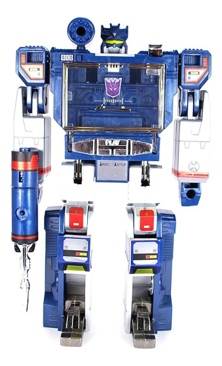
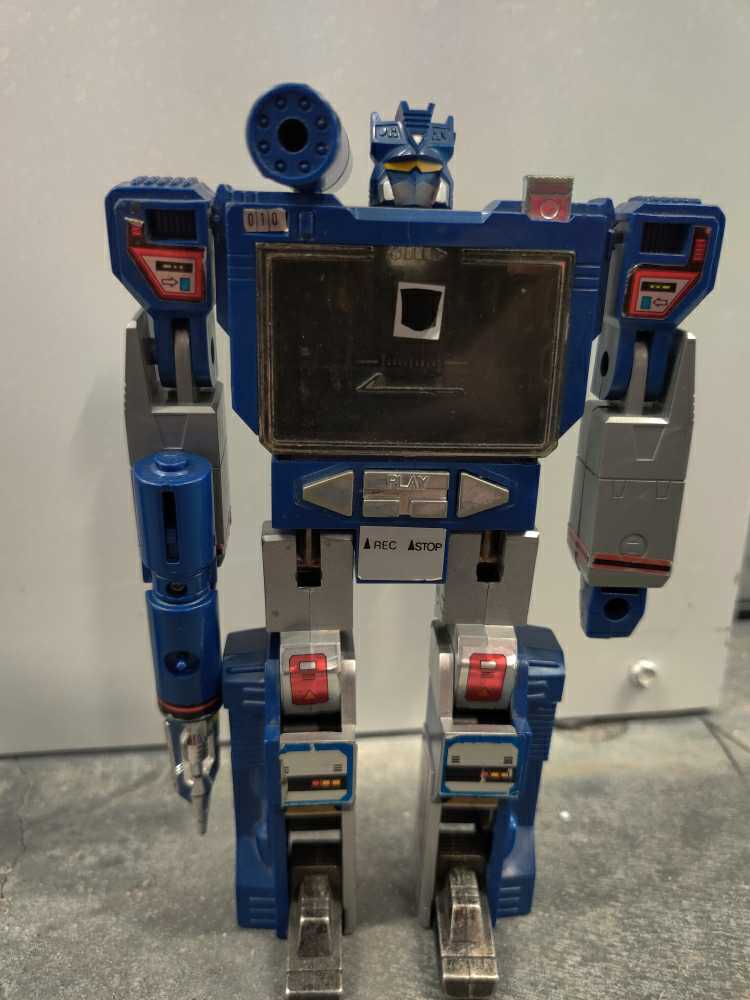
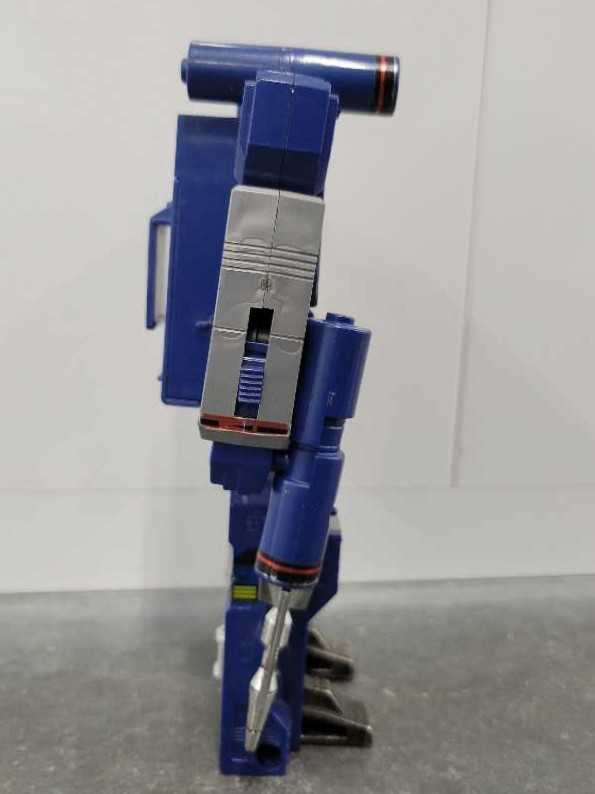
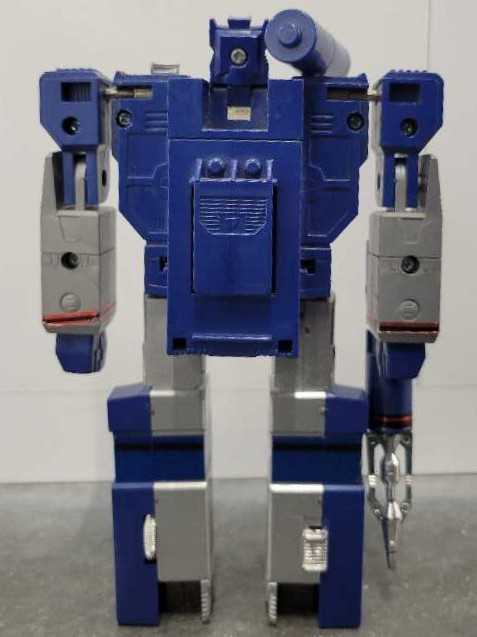
Soundwave began life as the Micro Change toy ”Cassette Man”, and went mostly unchanged when he was imported by Hasbro to become part of the Transformers toyline, save for exclusion of some accessories, and the removal of a molded ”Cassette Man” logo and ”MC-10” on his cassette door. He transforms into a realistically-sized blue and silver microcassette recorder, complete with an opening cassette door that can accommodate any of the numerous Mini-Cassette figures, and came packaged with Buzzsaw to fully exploit and advertise this interactive gimmick. Soundwave is armed with a shoulder-mounted cannon and a hand-held concussion blaster, which both transform into imitation batteries that store in a compartment on his back while he is in his alternate mode. The Hasbro instructions mistakenly state that a pair of trapezoid-shaped stickers intended to decorate these batteries should be attached to Soundwave’s legs.Takara’s release of Soundwave reinstated the extra Cassette Man accessories that Hasbro had excluded from their release: a set of headphones and a microphone, both non-functioning. To further emulate Cassette Man, Takara’s Soundwave came with Rumble, rather than Buzzsaw, and a clear plastic case that he could fit into in tape mode. Originally in the Cassette Man release, the figure came with either Rumble, Frenzy or Laserbeak, as different releases and copies varied. Soundwave’s rocket launcher featured a spring-loaded firing mechanism that Hasbro had removed, as they did with all such features at the time. Takara also made a running change to the mold, re-sculpting the recessed buttons on Soundwave’s pelvis into one solid, protruding piece, and moving the cassette door’s hinge from inside the figure’s chest to a lower, external position on either side of this new button assembly. This modification became the standard for all subsequent re-uses of the Soundwave mold.Aside from the aforementioned button remold, Soundwave’s first notable modification was the addition of a heat-sensitive rubsign to his chest in 1985. The popularity of Soundwave and his interactive tape gimmick was evident from an early stage: his toy continued to be sold throughout 1986, after the vast majority of his 1984 brethren had been removed from toy shelves; Mini-Cassette partners continued to be produced for him even after this, through 1988; and Soundwave and Buzzsaw were shipped to Australian retail again in 1990. Over the years there have been multiple reissues of Soundwave, and this article lists each distinct edition of the figure under its own heading.In Europe, Soundwave was released in three different subsequent versions that are most notable due to packaging variations: The first version, released in 1985, was manufactured by Takara and featured a Milton Bradley logo on its packaging; the second version, released in 1986, was also manufactured by Takara, but now featured a Hasbro logo on its packaging; and the third version, also released in 1986, was now manufactured by Ceji (the parent company of Joustra) and still featured a Hasbro logo on its packaging.
Japanese ID number: 17
Accessories (Hasbro release): Buzzsaw, rocket launcher, 3 rockets, concussion blaster
Accessories (Takara main release): Rumble, tape case, rocket launcher, 3 rockets, headphones, microphone, concussion blaster
Accessories (Takara ”Cassette Man” release): Rumble or Frenzy or Laserbeak, tape case, rocket launcher, 3 rockets, headphones, microphone, concussion blaster
Soundwave began life as the Micro Change toy ”Cassette Man”, and went mostly unchanged when he was imported by Hasbro to become part of the Transformers toyline, save for exclusion of some accessories, and the removal of a molded ”Cassette Man” logo and ”MC-10” on his cassette door. He transforms into a realistically-sized blue and silver microcassette recorder, complete with an opening cassette door that can accommodate any of the numerous Mini-Cassette figures, and came packaged with Buzzsaw to fully exploit and advertise this interactive gimmick. Soundwave is armed with a shoulder-mounted cannon and a hand-held concussion blaster, which both transform into imitation batteries that store in a compartment on his back while he is in his alternate mode. The Hasbro instructions mistakenly state that a pair of trapezoid-shaped stickers intended to decorate these batteries should be attached to Soundwave’s legs.Takara’s release of Soundwave reinstated the extra Cassette Man accessories that Hasbro had excluded from their release: a set of headphones and a microphone, both non-functioning. To further emulate Cassette Man, Takara’s Soundwave came with Rumble, rather than Buzzsaw, and a clear plastic case that he could fit into in tape mode. Originally in the Cassette Man release, the figure came with either Rumble, Frenzy or Laserbeak, as different releases and copies varied. Soundwave’s rocket launcher featured a spring-loaded firing mechanism that Hasbro had removed, as they did with all such features at the time. Takara also made a running change to the mold, re-sculpting the recessed buttons on Soundwave’s pelvis into one solid, protruding piece, and moving the cassette door’s hinge from inside the figure’s chest to a lower, external position on either side of this new button assembly. This modification became the standard for all subsequent re-uses of the Soundwave mold.Aside from the aforementioned button remold, Soundwave’s first notable modification was the addition of a heat-sensitive rubsign to his chest in 1985. The popularity of Soundwave and his interactive tape gimmick was evident from an early stage: his toy continued to be sold throughout 1986, after the vast majority of his 1984 brethren had been removed from toy shelves; Mini-Cassette partners continued to be produced for him even after this, through 1988; and Soundwave and Buzzsaw were shipped to Australian retail again in 1990. Over the years there have been multiple reissues of Soundwave, and this article lists each distinct edition of the figure under its own heading.In Europe, Soundwave was released in three different subsequent versions that are most notable due to packaging variations: The first version, released in 1985, was manufactured by Takara and featured a Milton Bradley logo on its packaging; the second version, released in 1986, was also manufactured by Takara, but now featured a Hasbro logo on its packaging; and the third version, also released in 1986, was now manufactured by Ceji (the parent company of Joustra) and still featured a Hasbro logo on its packaging.
Theme:
1984
Manufacturer:
Hasbro
Year:
1984
Country:
United States
Series:
G1
Model Number:
Blue Communications
Date Added:
2018-06-08 15:38:01
Automatic Estimated Date:
2024-01-25
Date Added:
2018-06-08 15:38:01