
Title:
The Matchbox Collection (Thundergryph)
Description:
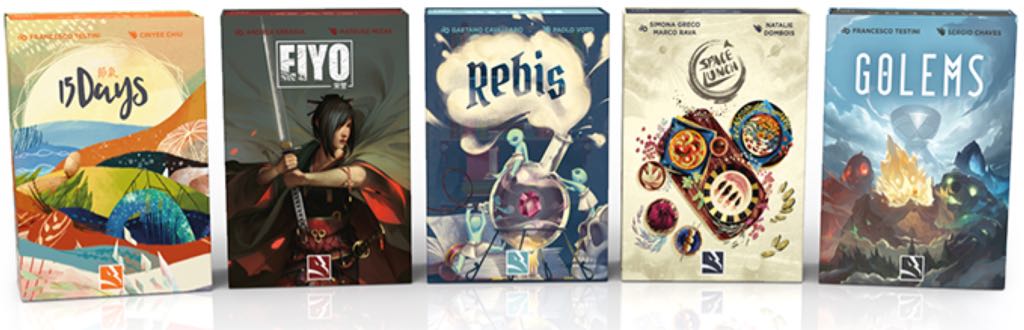
Presenting 5 euro-games, part of our new Matchbox Collection.
All games have been created along with Italian authors and the illustrators that you have already seen in our previous titles. Each game has its own identity, slide the matchbox and play in just 20 minutes with cards and small bits that will make the whole experience so satisfying!
Eiyo:
Designed by: Andrea Sbragia
Art by: Matthew Mizak
In Eiyo, you will need to confront hordes of enemies, trying not to be defeated, by gaining honour points determined by the opponents that you are taking down.
Each turn is divided into 2 phases: The samurai phase and the enemy phase.
In the samurai phase, you will draw 4 cards and then fight. You may never have more than 6 cards in hand.
During the fight phase you can deliberately attack or deflect your enemies, depending on your choices and possibilities. You choose the amount of cards to spend from your hand.
To face an enemy you will need to consider the enemy position and discard a Weapon card correspondingly. You can only use one of the positions shown on the card for each Weapon card you discard.
At any time, you can turn a Weapon card by 90 degrees clockwise to hit an enemy in a specific position by discarding the topmost card of your Weapon deck.
By attacking an enemy you will defeat only the topmost enemy of the overlapping row and will you gain honour points.
To deflect an enemy you must discard the corresponding Weapon card, and you must take a Deflect token and place it on top of the corresponding Enemy row. During this turn, you won’t receive damage from that row, but you won’t get honour points.
In the Enemy phase, all of the Enemies from the rows without a Deflect token on top, will attack you. The enemies will damage you based on the positions they occupy in their row. You will discard an amount of cards from your Weapon deck corresponding to the damage received by the enemies.
When using the deflect tokens, discard the topmost card of a row (without receiving honour points), before starting a new round.
You will lose the game if you run out of Weapon cards for the third time while there are still enemies to fight. To win the game you will need to survive having gained at least 40 honour points.
15 Days:
Designed by: Francesco Testini
Art by: Cinyee Chiu
In 15 days, you will take alternating turns until a player completes all 4 Season sets, or when 1 of the 2 season stacks is empty.
On each turn players choose 2 out of 4 possible actions:
Take 2 Season cards from any of the two season stacks to your hand. You may choose a different season stack for each card you draw.
Take 1 face-up card from either the market by drafting the topmost card of one of the 3 Market columns or the topmost card from the discard pile.
Place cards in one of the four corners of your player card considering each corner can only contain a single season composed of one card of each number.
Placing cards can be done by discarding other cards from your hand.
Finally, you can discard 2 cards from your hand, that are identical to any of the season cards already played in front of you, to take a wild card.
Immediately place the wild card in a position of your choice where a number is missing.
The wild card replaces the missing number.
By having the majority of Season cards of 1 type, take the corresponding wooden animal. Wooden animals give different small advantages, like increasing your hand limit or getting a discount when placing cards.
At the end of the game score: 1 point per card, counting only the longest uninterrupted sequence of numbers in each season. 2 points for every Wooden animal you own, and -2 points for every empty corner on the player card.
-description from publisher
The player with the most points will win the game.
Space Lunch:
Designed by: Marco Rava, Simona Greco
Art by: Natalie Dombois
In Space Lunch, you take alternating turns and collect food cards until only six food cards remain in the grid, or until a player completes three sets of three food cards of the same type.
Each turn is divided into two phases: The beverage phase and the food phase. At the beginning of your turn, during the beverage phase, players can use three beverage cards of the same type to use the corresponding beverage ability.
During the food phase, players must take one food card from the column where the pick token is placed and its corresponding beverage. After performing this action, the player moves the pick token to the next column to the right. If the pick token is placed below the rightmost column, move the pick token to the leftmost column.
The first player to complete three sets of three food cards of the same type wins. If no one does this and only six food cards remain in the grid, the player with the most pairs of cards of the same type wins, considering that a set of three food cards does not count as a pair.
Golems:
Designed by: Francesco Testini
Art by: Sergio Chaves
In Golems, you will need to collect resources and summon Golems to score victory points while trying not to be anticipated by your opponent.
You will take alternating turns. During each turn you collect cards from the grid by using your Gems and choosing how to use the collected cards to maximize your strategy.
There are 3 types of cards: Golem cards, Gem cards, Rune cards.
To pick a card from a row that contains 3 cards, place a Gem from your reserve on each of the 2 undesired cards and then take the card.
To pick a card from a row that contains 2 cards, move the Gem from the desired card to the undesired card.
To pick the last card of a row, collect the Gems and then take the card. Immediately refill the row with 3 new cards from the deck.
During your turn:
- You may use a Golem card as a resource by placing the card upside down in front of you.
- You may summon a Golem if you have all the resources needed to do this, by placing the card face-up next to your resource cards and by discarding 1 to 3 cards with the matching resources of the Golem you want to summon. Tuck the cards under the summoned Golem. These resources cannot be used anymore, but each card will score 1 point at the end of the game.
- You may use a Rune card as a resource.
- You may take a Rune card in hand and use it to score additional points, but only if you have at least 3 Gems in your reserve and pay 1 Gem to the supply.
- You may take a Gem card in hand to gain the bonus shown on the card.
- You may take a Gem card to gain set-collection points by placing the card face-down next to your Rune cards and creating Gem dust.
The game ends when you are not able to refill a row with new cards.
Score 2 points for every summoned Golem, 1 point for every card under your summoned Golems, additional victory points for your collected Gem dust symbols, and additional points depending on your Rune cards in hand.
Whoever has the most points, wins. In the case of a tie, whoever collected the most points for their summoned Golems wins.
Rebis:
Designed by: Gaetano Cavallaro
Art by: Paolo Voto
In Rebis, players will take turns by drawing a card from the Library deck and play cards either to their own shelf or to the shelf of another player, by piling up Library cards up to 13 to accumulate victory points.
On your turn, you can play either 1 card to your active shelf or 2 cards of the same number. You can do this as long as the sum of the book weight shown in the cards of the Active Shelf does not exceed 13 after placing the card. In Rebis there is no hand limit.
Alternatively, you can play 1 card to another player’s Active Shelf. You may choose to play your card with the positive or the negative value by considering that the sum of the book victory points in a shelf must never be negative. Whenever you play a card with a negative point value to another player’s Shelf, you take 1 card from the Library deck.
If your card causes the sum to exceed 13 points, you close the shelf by playing your card face down to create a new Active Shelf for the player. If you close another player’s Active Shelf, you receive 1 Mixture token and the other player takes 1 card from the Library deck.
At the beginning of your turn, after drawing a card, you may place as many golden dust mixture tokens as you want exclusively on your active shelf. Mixture tokens act as multipliers of the victory point value on the shelf where they are placed.
When there are no more golden dust mixture tokens left, the players will take a golden mixture token instead, which can be placed immediately after, in any shelf of your preference.
The game ends when the deck runs out or as soon as all mixture tokens have been taken, excluding the red mixture token. Count the total negative book value visible in all of your shelves and sum it to the amount of cards in your hand. The player with the higher result will receive the red mixture token, which will be placed in any shelf of the player’s preference.
When the game ends, count the total book value of each shelf and multiply it if there are any mixture tokens on the shelf. The player who has the highest total book value is the winner.
All games have been created along with Italian authors and the illustrators that you have already seen in our previous titles. Each game has its own identity, slide the matchbox and play in just 20 minutes with cards and small bits that will make the whole experience so satisfying!
Eiyo:
Designed by: Andrea Sbragia
Art by: Matthew Mizak
In Eiyo, you will need to confront hordes of enemies, trying not to be defeated, by gaining honour points determined by the opponents that you are taking down.
Each turn is divided into 2 phases: The samurai phase and the enemy phase.
In the samurai phase, you will draw 4 cards and then fight. You may never have more than 6 cards in hand.
During the fight phase you can deliberately attack or deflect your enemies, depending on your choices and possibilities. You choose the amount of cards to spend from your hand.
To face an enemy you will need to consider the enemy position and discard a Weapon card correspondingly. You can only use one of the positions shown on the card for each Weapon card you discard.
At any time, you can turn a Weapon card by 90 degrees clockwise to hit an enemy in a specific position by discarding the topmost card of your Weapon deck.
By attacking an enemy you will defeat only the topmost enemy of the overlapping row and will you gain honour points.
To deflect an enemy you must discard the corresponding Weapon card, and you must take a Deflect token and place it on top of the corresponding Enemy row. During this turn, you won’t receive damage from that row, but you won’t get honour points.
In the Enemy phase, all of the Enemies from the rows without a Deflect token on top, will attack you. The enemies will damage you based on the positions they occupy in their row. You will discard an amount of cards from your Weapon deck corresponding to the damage received by the enemies.
When using the deflect tokens, discard the topmost card of a row (without receiving honour points), before starting a new round.
You will lose the game if you run out of Weapon cards for the third time while there are still enemies to fight. To win the game you will need to survive having gained at least 40 honour points.
15 Days:
Designed by: Francesco Testini
Art by: Cinyee Chiu
In 15 days, you will take alternating turns until a player completes all 4 Season sets, or when 1 of the 2 season stacks is empty.
On each turn players choose 2 out of 4 possible actions:
Take 2 Season cards from any of the two season stacks to your hand. You may choose a different season stack for each card you draw.
Take 1 face-up card from either the market by drafting the topmost card of one of the 3 Market columns or the topmost card from the discard pile.
Place cards in one of the four corners of your player card considering each corner can only contain a single season composed of one card of each number.
Placing cards can be done by discarding other cards from your hand.
Finally, you can discard 2 cards from your hand, that are identical to any of the season cards already played in front of you, to take a wild card.
Immediately place the wild card in a position of your choice where a number is missing.
The wild card replaces the missing number.
By having the majority of Season cards of 1 type, take the corresponding wooden animal. Wooden animals give different small advantages, like increasing your hand limit or getting a discount when placing cards.
At the end of the game score: 1 point per card, counting only the longest uninterrupted sequence of numbers in each season. 2 points for every Wooden animal you own, and -2 points for every empty corner on the player card.
-description from publisher
The player with the most points will win the game.
Space Lunch:
Designed by: Marco Rava, Simona Greco
Art by: Natalie Dombois
In Space Lunch, you take alternating turns and collect food cards until only six food cards remain in the grid, or until a player completes three sets of three food cards of the same type.
Each turn is divided into two phases: The beverage phase and the food phase. At the beginning of your turn, during the beverage phase, players can use three beverage cards of the same type to use the corresponding beverage ability.
During the food phase, players must take one food card from the column where the pick token is placed and its corresponding beverage. After performing this action, the player moves the pick token to the next column to the right. If the pick token is placed below the rightmost column, move the pick token to the leftmost column.
The first player to complete three sets of three food cards of the same type wins. If no one does this and only six food cards remain in the grid, the player with the most pairs of cards of the same type wins, considering that a set of three food cards does not count as a pair.
Golems:
Designed by: Francesco Testini
Art by: Sergio Chaves
In Golems, you will need to collect resources and summon Golems to score victory points while trying not to be anticipated by your opponent.
You will take alternating turns. During each turn you collect cards from the grid by using your Gems and choosing how to use the collected cards to maximize your strategy.
There are 3 types of cards: Golem cards, Gem cards, Rune cards.
To pick a card from a row that contains 3 cards, place a Gem from your reserve on each of the 2 undesired cards and then take the card.
To pick a card from a row that contains 2 cards, move the Gem from the desired card to the undesired card.
To pick the last card of a row, collect the Gems and then take the card. Immediately refill the row with 3 new cards from the deck.
During your turn:
- You may use a Golem card as a resource by placing the card upside down in front of you.
- You may summon a Golem if you have all the resources needed to do this, by placing the card face-up next to your resource cards and by discarding 1 to 3 cards with the matching resources of the Golem you want to summon. Tuck the cards under the summoned Golem. These resources cannot be used anymore, but each card will score 1 point at the end of the game.
- You may use a Rune card as a resource.
- You may take a Rune card in hand and use it to score additional points, but only if you have at least 3 Gems in your reserve and pay 1 Gem to the supply.
- You may take a Gem card in hand to gain the bonus shown on the card.
- You may take a Gem card to gain set-collection points by placing the card face-down next to your Rune cards and creating Gem dust.
The game ends when you are not able to refill a row with new cards.
Score 2 points for every summoned Golem, 1 point for every card under your summoned Golems, additional victory points for your collected Gem dust symbols, and additional points depending on your Rune cards in hand.
Whoever has the most points, wins. In the case of a tie, whoever collected the most points for their summoned Golems wins.
Rebis:
Designed by: Gaetano Cavallaro
Art by: Paolo Voto
In Rebis, players will take turns by drawing a card from the Library deck and play cards either to their own shelf or to the shelf of another player, by piling up Library cards up to 13 to accumulate victory points.
On your turn, you can play either 1 card to your active shelf or 2 cards of the same number. You can do this as long as the sum of the book weight shown in the cards of the Active Shelf does not exceed 13 after placing the card. In Rebis there is no hand limit.
Alternatively, you can play 1 card to another player’s Active Shelf. You may choose to play your card with the positive or the negative value by considering that the sum of the book victory points in a shelf must never be negative. Whenever you play a card with a negative point value to another player’s Shelf, you take 1 card from the Library deck.
If your card causes the sum to exceed 13 points, you close the shelf by playing your card face down to create a new Active Shelf for the player. If you close another player’s Active Shelf, you receive 1 Mixture token and the other player takes 1 card from the Library deck.
At the beginning of your turn, after drawing a card, you may place as many golden dust mixture tokens as you want exclusively on your active shelf. Mixture tokens act as multipliers of the victory point value on the shelf where they are placed.
When there are no more golden dust mixture tokens left, the players will take a golden mixture token instead, which can be placed immediately after, in any shelf of your preference.
The game ends when the deck runs out or as soon as all mixture tokens have been taken, excluding the red mixture token. Count the total negative book value visible in all of your shelves and sum it to the amount of cards in your hand. The player with the higher result will receive the red mixture token, which will be placed in any shelf of the player’s preference.
When the game ends, count the total book value of each shelf and multiply it if there are any mixture tokens on the shelf. The player who has the highest total book value is the winner.
Max Number of Players:
1-4
Category:
Card Game
Show More
Publisher:
ThunderGryph Games
Playing Time:
20
Year Published:
2021
Designer:
Various
Show More
Artist:
Various
Show More
Suggested Ages:
14+
Date Added:
2021-11-29 12:04:46
Automatic Estimated Value:
~£37.06
Automatic Estimated Date:
2025-11-29
Date Added:
2021-11-29 12:04:46