Title:
Main Street
Genre:
Literature
Show More
Binding:
Hardcover
Narrative:
Third Person
Type of Book:
Fiction
Number of Pages:
451
Number of Chapters:
39
Date Added:
2018-06-26 16:06:16
Synopsis:
Evaluating the value of a signed first edition of Main Street by Sinclair Lewis requires considering several factors, including the book’s edition, condition, provenance, and market demand. Based on the images provided and my knowledge, here’s an analysis:
Key Observations:
1 Edition and Printing:
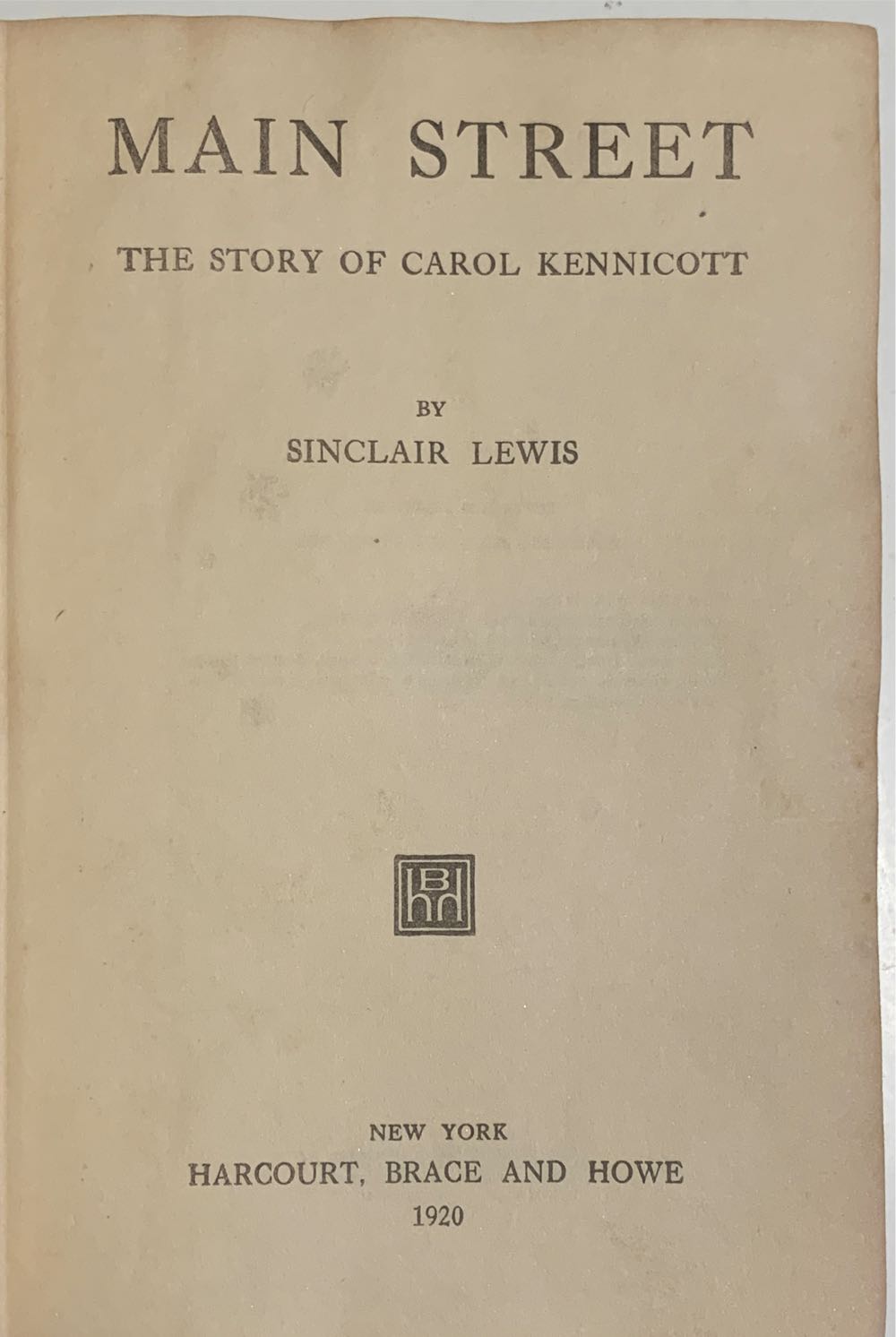
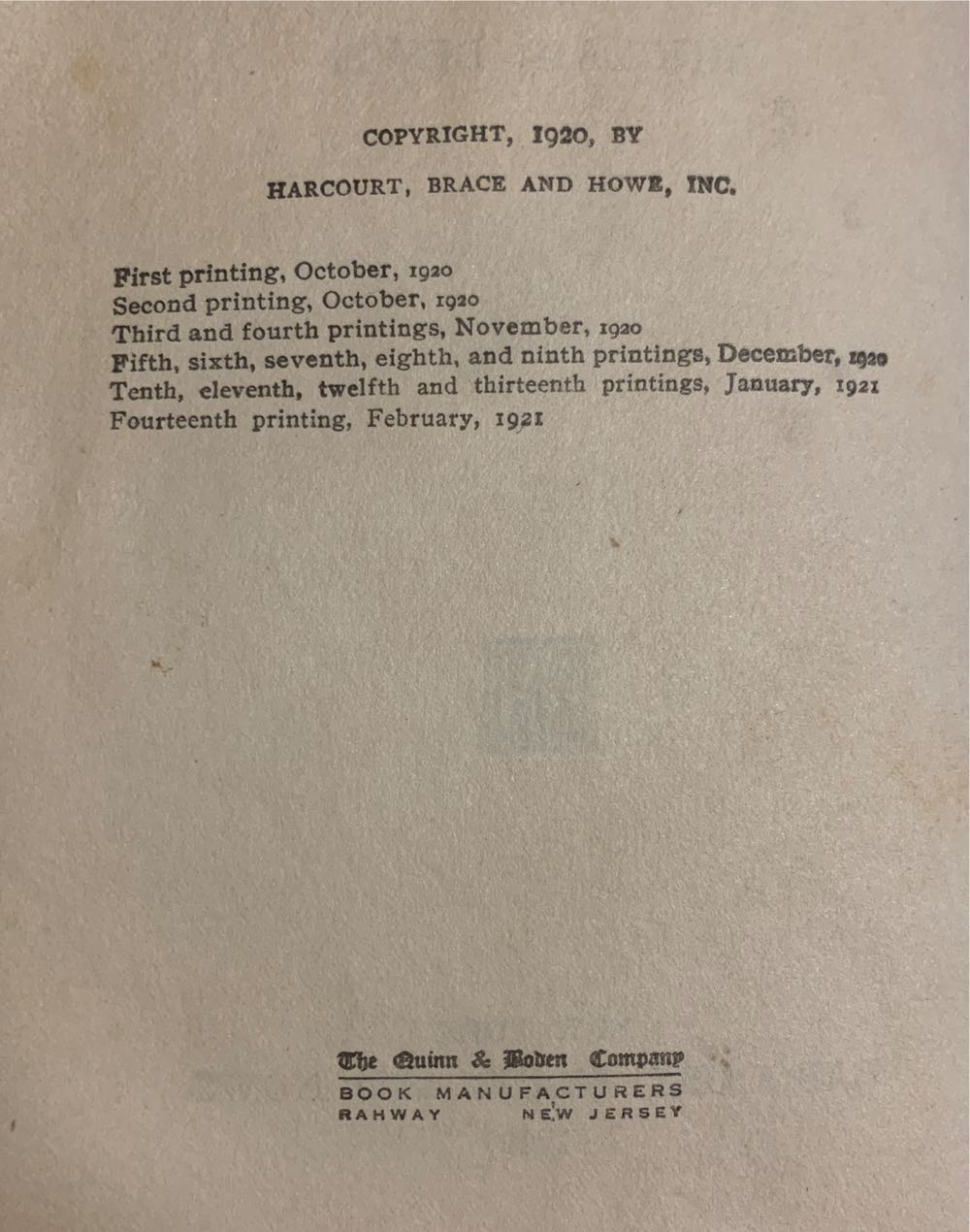
◦ The title page indicates the book was published by Harcourt, Brace and Howe in 1920, with a list of printings from October 1920 to February 1921. The presence of multiple early printings suggests this could be a first edition, with the first printing being the most valuable. However, the exact printing (e.g., first vs. second) cannot be definitively determined from the images alone without a detailed examination of the copyright page and other edition points (e.g., specific typesetting or binding details). First editions of Main Street typically have a single printing line stating “First printing, October, 1920” without additional printings listed.
2 Signature:
◦ The book appears to be signed by Sinclair Lewis, which significantly increases its value. The signature on the title page includes a dedication (“To Shine Palmer of Winona Ariel, Main Street, and ___ Sinclair Lewis”), adding to its uniqueness and potential worth. The legibility and authenticity of the signature are critical. A genuine signature from Lewis, especially with a personal inscription, is a major factor in determining value.
3 Condition:
◦ The cover shows signs of wear, such as discoloration and slight fraying, which is typical for a book over 100 years old. The internal pages also show age-related marks and stains. The condition of the dust jacket (if present) would be a significant factor, as first editions with original dust jackets in good condition are much rarer and more valuable. Without a dust jacket, the value is reduced, though the signature compensates somewhat.
4 Provenance:
◦ The dedication to “Shine Palmer of Winona” suggests a personal connection, possibly to a real individual or a character-inspired name. If “Winona” refers to Winona, Minnesota (Lewis’s birthplace), this could enhance the book’s historical or sentimental value. Provenance documentation (e.g., a letter or receipt tying the book to Lewis) would further boost its worth.
5 Market Demand:
◦ Sinclair Lewis was the first American to win the Nobel Prize in Literature (1930), and Main Street (1920) is one of his most famous works, a satirical novel critiquing small-town America. Signed copies, especially first editions, are highly sought after by collectors of American literature.
Estimated Value:
• Unsigned First Edition (no dust jacket): Typically ranges from $100 to $500, depending on condition.
• Signed First Edition (no dust jacket): Values can range from $1,000 to $3,000 or more, depending on the signature’s authenticity, the book’s condition, and the presence of a meaningful inscription.
• Signed First Edition (with dust jacket): Could fetch $5,000 to $10,000+ if the jacket is in good condition, as original dust jackets are exceedingly rare.
Given the apparent wear on the cover and the lack of visible dust jacket in the images, a conservative estimate for this signed copy would likely fall in the $1,500 to $3,000 range, assuming it is a first printing and the signature is authenticated. If it is a later printing (e.g., second or third), the value might drop to $500 to $1,000.
Recommendations:
• Authentication: Have the signature evaluated by a professional (e.g., through an auction house like Sotheby’s or Christie’s, or a book appraiser) to confirm it is genuine.
• Condition Assessment: Check for the dust jacket, complete pages, and any additional markings or damage.
• Further Research: Consult a bibliography of Sinclair Lewis’s works (e.g., by Claude Lewis) or a rare book dealer to confirm the exact edition.
For a more precise valuation, I can search current market trends and auction records if you’d like. Would you like me to proceed with that?
Here’s a summary and value estimate for the book ”Main Street” by Sinclair Lewis:
Book Summary:
The images show a copy of Sinclair Lewis’s ”Main Street: The Story of Carol Kennicott.”
* Author: Sinclair Lewis
* Title: Main Street: The Story of Carol Kennicott
* Publisher: Harcourt, Brace and Howe, New York
* Copyright Year: 1920
* Edition/Printing: The copyright page clearly lists multiple printings: ”First printing, October, 1920” through ”Fourteenth printing, February, 1921.” This indicates that the copy you have is a later printing from 1921, not the true first printing from October 1920.
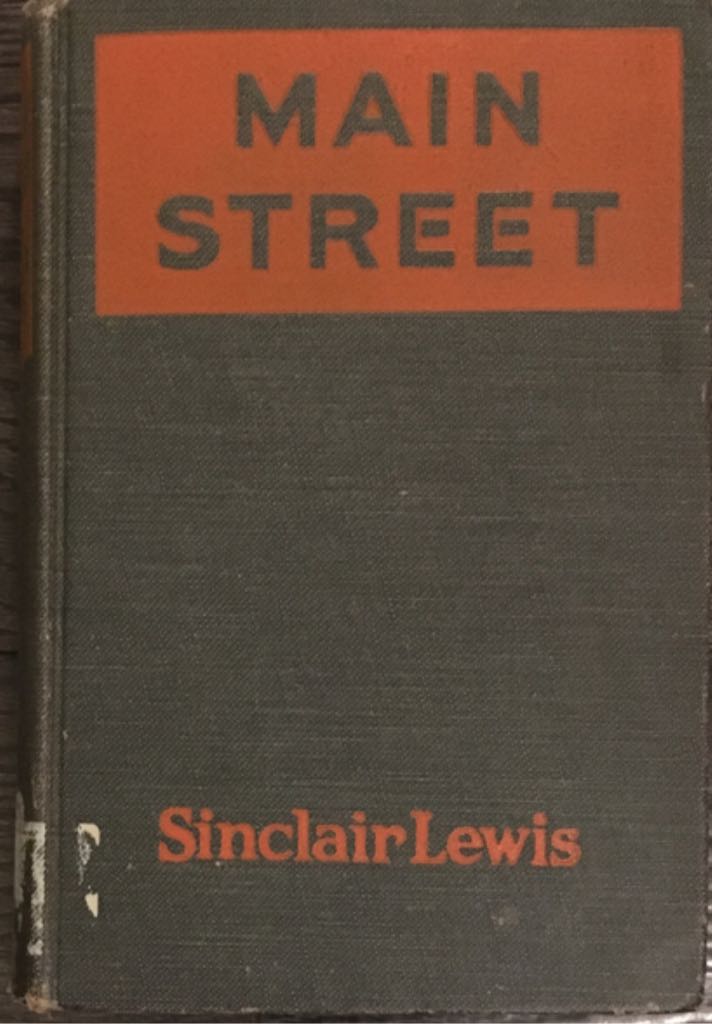
* Binding: The book has a cloth binding, likely blue or dark with an orange/tan block on the front cover containing the title. The binding appears to show some wear.
* Inscription/Signature: One image shows a handwritten inscription that includes ”Josephine Gallot of Indian Hill, Main Street,” and then a signature that appears to be ”Sinclair Lewis.” This suggests it is a signed copy by the author, and potentially a presentation copy with a specific recipient and location mentioned.
Value Estimate:
The value of this book is significantly influenced by the fact that it is a signed copy, but also by the fact that it is a later printing and its physical condition.
* Literary Significance: ”Main Street” is a landmark novel in American literature, a critique of small-town life, and a key work by Sinclair Lewis, who went on to become the first American to win the Nobel Prize in Literature (in 1930). This makes even later printings collectible.
* Later Printing vs. First Printing: The primary factor affecting value downwards from a collector’s standpoint is that this is a later printing (14th printing, February 1921) rather than the true first printing (October 1920). First printings are significantly more valuable.
* Author’s Signature: This is a major value enhancer and the most important positive factor for this specific copy. A genuine signature by Sinclair Lewis, especially on one of his most famous works, adds substantial value. The inscription ”Josephine Gallot of Indian Hill, Main Street” adds a unique personal touch, making it a presentation copy.
* Condition: The cover shows visible wear. Without seeing the interior pages or spine integrity, it’s hard to give a precise condition, but external wear will reduce its value compared to a pristine copy. There is no dust jacket visible, which is common for books of this age but does impact value as books with original jackets are rarer and more desirable.
Estimated Value Range (assuming genuine signature):
Given that it’s a signed later printing (14th printing) of ”Main Street” by Sinclair Lewis, in likely good to fair condition, and without a dust jacket:
* The estimated value range would likely be $200 to $700.
* The lower end would be for copies with more significant wear.
* The higher end would be for copies in relatively better condition for their age, with the strong positive being the clear and authentic signature.
For context and comparison:
* A true first printing (October 1920) of ”Main Street” in good condition without a dust jacket might range from $100-$300.
* A true first printing with a good original dust jacket could be worth $500 - $1,500+, and a signed first printing with a dust jacket would be significantly more, easily in the thousands.
To get a more precise valuation:
* Authenticate the Signature: While the signature appears consistent with Sinclair Lewis’s known hand, professional authentication would be crucial for a higher-value item.
* Assess Overall Condition Thoroughly: Look for any damage to the binding, loose pages, significant foxing, or previous repairs.
* Consult a Rare Book Specialist: For a signed literary first edition (even if a later printing of the first edition), a reputable rare book dealer or appraiser specializing in 20th-century American literature can provide the most accurate valuation.
* Research Completed Sales: Check auction records and reputable bookseller sites (like AbeBooks, Biblio) for ”Sinclair Lewis Main Street signed” or ”Main Street 14th printing signed” to find comparable sales. Pay close attention to the listed condition and whether a dust jacket was present.
Based on the images provided, here is an overview and analysis of the book, ”Main Street” by Sinclair Lewis.
Overview and Historical Importance
* Book Title: Main Street: The Story of Carol Kennicott
* Author: Sinclair Lewis
* Publisher: Harcourt, Brace and Howe, New York
* Copyright Date: 1920
”Main Street” is a historically significant novel in American literature. Published in 1920, it became a national sensation and was the best-selling work of fiction in the United States for 1921. The book is a sharp and satirical critique of small-town American life, and its portrayal of provincialism and conformity resonated deeply with readers. Its success contributed to Sinclair Lewis’s international recognition and, ultimately, his winning the Nobel Prize in Literature in 1930, making him the first American to receive the award. The novel is considered a classic of American Realism.
Edition Analysis
Based on the title page and copyright page:
* Edition: This is a first edition.
* Printing: The copyright page lists multiple printings, with the ”First printing” in ”October, 1920” and the ”Fourteenth printing” in ”February, 1921.” This means the book was reprinted many times in a short period due to its popularity. The fact that the book has 14 printings listed on the copyright page indicates that it is a later printing of the first edition, not a first printing. The book was a commercial sensation, and the publisher had to print new copies almost monthly to keep up with demand.
A true ”first printing” of the first edition will only list ”First printing, October, 1920” and nothing after it. This copy, however, shows the full printing history up to February 1921.
Signatures and Significance
* Sinclair Lewis Signature: The image shows what
Key Observations:
1 Edition and Printing:
◦ The title page indicates the book was published by Harcourt, Brace and Howe in 1920, with a list of printings from October 1920 to February 1921. The presence of multiple early printings suggests this could be a first edition, with the first printing being the most valuable. However, the exact printing (e.g., first vs. second) cannot be definitively determined from the images alone without a detailed examination of the copyright page and other edition points (e.g., specific typesetting or binding details). First editions of Main Street typically have a single printing line stating “First printing, October, 1920” without additional printings listed.
2 Signature:
◦ The book appears to be signed by Sinclair Lewis, which significantly increases its value. The signature on the title page includes a dedication (“To Shine Palmer of Winona Ariel, Main Street, and ___ Sinclair Lewis”), adding to its uniqueness and potential worth. The legibility and authenticity of the signature are critical. A genuine signature from Lewis, especially with a personal inscription, is a major factor in determining value.
3 Condition:
◦ The cover shows signs of wear, such as discoloration and slight fraying, which is typical for a book over 100 years old. The internal pages also show age-related marks and stains. The condition of the dust jacket (if present) would be a significant factor, as first editions with original dust jackets in good condition are much rarer and more valuable. Without a dust jacket, the value is reduced, though the signature compensates somewhat.
4 Provenance:
◦ The dedication to “Shine Palmer of Winona” suggests a personal connection, possibly to a real individual or a character-inspired name. If “Winona” refers to Winona, Minnesota (Lewis’s birthplace), this could enhance the book’s historical or sentimental value. Provenance documentation (e.g., a letter or receipt tying the book to Lewis) would further boost its worth.
5 Market Demand:
◦ Sinclair Lewis was the first American to win the Nobel Prize in Literature (1930), and Main Street (1920) is one of his most famous works, a satirical novel critiquing small-town America. Signed copies, especially first editions, are highly sought after by collectors of American literature.
Estimated Value:
• Unsigned First Edition (no dust jacket): Typically ranges from $100 to $500, depending on condition.
• Signed First Edition (no dust jacket): Values can range from $1,000 to $3,000 or more, depending on the signature’s authenticity, the book’s condition, and the presence of a meaningful inscription.
• Signed First Edition (with dust jacket): Could fetch $5,000 to $10,000+ if the jacket is in good condition, as original dust jackets are exceedingly rare.
Given the apparent wear on the cover and the lack of visible dust jacket in the images, a conservative estimate for this signed copy would likely fall in the $1,500 to $3,000 range, assuming it is a first printing and the signature is authenticated. If it is a later printing (e.g., second or third), the value might drop to $500 to $1,000.
Recommendations:
• Authentication: Have the signature evaluated by a professional (e.g., through an auction house like Sotheby’s or Christie’s, or a book appraiser) to confirm it is genuine.
• Condition Assessment: Check for the dust jacket, complete pages, and any additional markings or damage.
• Further Research: Consult a bibliography of Sinclair Lewis’s works (e.g., by Claude Lewis) or a rare book dealer to confirm the exact edition.
For a more precise valuation, I can search current market trends and auction records if you’d like. Would you like me to proceed with that?
Here’s a summary and value estimate for the book ”Main Street” by Sinclair Lewis:
Book Summary:
The images show a copy of Sinclair Lewis’s ”Main Street: The Story of Carol Kennicott.”
* Author: Sinclair Lewis
* Title: Main Street: The Story of Carol Kennicott
* Publisher: Harcourt, Brace and Howe, New York
* Copyright Year: 1920
* Edition/Printing: The copyright page clearly lists multiple printings: ”First printing, October, 1920” through ”Fourteenth printing, February, 1921.” This indicates that the copy you have is a later printing from 1921, not the true first printing from October 1920.
* Binding: The book has a cloth binding, likely blue or dark with an orange/tan block on the front cover containing the title. The binding appears to show some wear.
* Inscription/Signature: One image shows a handwritten inscription that includes ”Josephine Gallot of Indian Hill, Main Street,” and then a signature that appears to be ”Sinclair Lewis.” This suggests it is a signed copy by the author, and potentially a presentation copy with a specific recipient and location mentioned.
Value Estimate:
The value of this book is significantly influenced by the fact that it is a signed copy, but also by the fact that it is a later printing and its physical condition.
* Literary Significance: ”Main Street” is a landmark novel in American literature, a critique of small-town life, and a key work by Sinclair Lewis, who went on to become the first American to win the Nobel Prize in Literature (in 1930). This makes even later printings collectible.
* Later Printing vs. First Printing: The primary factor affecting value downwards from a collector’s standpoint is that this is a later printing (14th printing, February 1921) rather than the true first printing (October 1920). First printings are significantly more valuable.
* Author’s Signature: This is a major value enhancer and the most important positive factor for this specific copy. A genuine signature by Sinclair Lewis, especially on one of his most famous works, adds substantial value. The inscription ”Josephine Gallot of Indian Hill, Main Street” adds a unique personal touch, making it a presentation copy.
* Condition: The cover shows visible wear. Without seeing the interior pages or spine integrity, it’s hard to give a precise condition, but external wear will reduce its value compared to a pristine copy. There is no dust jacket visible, which is common for books of this age but does impact value as books with original jackets are rarer and more desirable.
Estimated Value Range (assuming genuine signature):
Given that it’s a signed later printing (14th printing) of ”Main Street” by Sinclair Lewis, in likely good to fair condition, and without a dust jacket:
* The estimated value range would likely be $200 to $700.
* The lower end would be for copies with more significant wear.
* The higher end would be for copies in relatively better condition for their age, with the strong positive being the clear and authentic signature.
For context and comparison:
* A true first printing (October 1920) of ”Main Street” in good condition without a dust jacket might range from $100-$300.
* A true first printing with a good original dust jacket could be worth $500 - $1,500+, and a signed first printing with a dust jacket would be significantly more, easily in the thousands.
To get a more precise valuation:
* Authenticate the Signature: While the signature appears consistent with Sinclair Lewis’s known hand, professional authentication would be crucial for a higher-value item.
* Assess Overall Condition Thoroughly: Look for any damage to the binding, loose pages, significant foxing, or previous repairs.
* Consult a Rare Book Specialist: For a signed literary first edition (even if a later printing of the first edition), a reputable rare book dealer or appraiser specializing in 20th-century American literature can provide the most accurate valuation.
* Research Completed Sales: Check auction records and reputable bookseller sites (like AbeBooks, Biblio) for ”Sinclair Lewis Main Street signed” or ”Main Street 14th printing signed” to find comparable sales. Pay close attention to the listed condition and whether a dust jacket was present.
Based on the images provided, here is an overview and analysis of the book, ”Main Street” by Sinclair Lewis.
Overview and Historical Importance
* Book Title: Main Street: The Story of Carol Kennicott
* Author: Sinclair Lewis
* Publisher: Harcourt, Brace and Howe, New York
* Copyright Date: 1920
”Main Street” is a historically significant novel in American literature. Published in 1920, it became a national sensation and was the best-selling work of fiction in the United States for 1921. The book is a sharp and satirical critique of small-town American life, and its portrayal of provincialism and conformity resonated deeply with readers. Its success contributed to Sinclair Lewis’s international recognition and, ultimately, his winning the Nobel Prize in Literature in 1930, making him the first American to receive the award. The novel is considered a classic of American Realism.
Edition Analysis
Based on the title page and copyright page:
* Edition: This is a first edition.
* Printing: The copyright page lists multiple printings, with the ”First printing” in ”October, 1920” and the ”Fourteenth printing” in ”February, 1921.” This means the book was reprinted many times in a short period due to its popularity. The fact that the book has 14 printings listed on the copyright page indicates that it is a later printing of the first edition, not a first printing. The book was a commercial sensation, and the publisher had to print new copies almost monthly to keep up with demand.
A true ”first printing” of the first edition will only list ”First printing, October, 1920” and nothing after it. This copy, however, shows the full printing history up to February 1921.
Signatures and Significance
* Sinclair Lewis Signature: The image shows what
Author:
Sinclair Lewis
Show More
Publisher:
Harcourt, Brace, And Howe
Place of Printing:
Harcourt, Brace And Company, Inc.
Publication Date:
1920-01-01
Publication Year:
1921
Number of Copies:
1
Language:
English
Publisher Location:
New York
Date Added:
2018-06-26 16:06:16