Title:
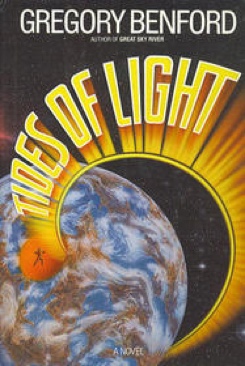
Tides Of Light
Genre:
Science Fiction
Show More
Series:
Galactic Center
Binding:
Hardcover
Edition:
2nd
Type of Book:
Fiction
Number of Pages:
362
Date Added:
2018-06-26 16:43:23
Synopsis:
Book 4 LA Times Review:
Planet of Mechs and Men : TIDES OF LIGHT by Gregory Benford (Bantam Spectra/ Bantam Books: $17.95; 336 pp.; 0-553-05322-1)
April 09, 1989, Paul Preuss - Preuss writes fiction, nonfiction and documentary film scripts about science. His most recent novel is "Starfire” (Tor Books, 1988).
Science-fiction author Gregory Benford writes some of the very best of the so-called "hard” stuff. He knows his science and his scientists--he is one himself, a professor of physics at UC Irvine--and if the theories and gadgets in his stories seem as important as the people, that is wholly appropriate, for the collision of living with nonliving intelligence is Benford’s great theme.
"Tides of Light” is one of a series of novels chronicling the exploits of the human Family Bishop in their unending battle against the evil "mechs,” an ancient race of intelligent machines that have infested the center of the Galaxy. Herein the Bishops and their leader, Cap’n Killeen, undergo further extraordinary adventures; in one virtuoso descriptive sequence, Benford propels his hero right through the center of a planet, which has been cored like an apple by aliens wielding a fearsome, planet-cutting "cosmic string.” In the end, through pluck (and perhaps too much coincidence-straining luck), Killeen and most of his little band of relatives live on to fight another day.
Benford is a hard-working, an inventive, and, above all, a generous writer. He really wants us to know what it might feel like to have computer chips embedded in our spines, each of which holds the memories of one of our ancestors, all of which clamor for our attention because only through our consciousness can they experience continued life. He really wants us to know what it might be like to be a "cyber,” half machine, half giant bug, enmeshed in the political struggles of an anthill as big as a planet.
And Benford really wants us to understand the ontogeny of a being that could live in the vacuum of space by feeding upon comets and asteroids, growing over eons from a tiny seed to a creature one-third the diameter of the Earth before scattering its own seed to the stellar winds. This "Skysower” is tangential to Benford’s story but crucial to his deeper purpose, which is to breathe fictional life into dry theory--in this instance, into computer scientist Marvin Minsky’s notions of the "society of mind” that may underlie natural and artificial intelligence. For this kind of responsible speculation, dedicated fans have elevated Benford to a position in the science fiction pantheon not far below that of the late Robert A. Heinlein, the dean of hard science fiction.
"Tides of Light” shares an imaginary universe with many of Benford’s earlier works, and it is a grim future history indeed, the saga of a Galaxy teeming with diabolical machines whose only apparent purpose is to wipe out all living things. Coming from a scientist who has been an outspoken supporter of our former President’s "Star Wars” strategic defense program--the ultimate in technological optimism--Benford’s sour opinion of machine motivation is not encouraging.
Nor is his opinion of human nature much more cheerful. Benford advances his plot by unremitting confrontation, from all-out war to philosophical disputation to office politics; indeed, sometimes it seems rather as if the universe were a vast chicken coop and the sole purpose of intelligence (natural and artificial) were to determine the pecking order. Thus the novel’s central human relationship, Killeen’s love for his son, is described chiefly in terms of the Cap’n’s efforts to discipline the rebellious lad. Nevertheless the bond between father and son is persuasively rendered, a measure of Benford’s feeling for his characters.
But the non-fan will find Benford rough going. Sci-fi jargon abounds; moreover, Benford is an avowed admirer of William Faulkner--too bad, considering that Faulknerian prose is a writhing snake that Faulker himself could not always keep a grip on--and his prose is to minimalism as ultraviolet is to infrared: "It coiled, clotted scintillant ridges working with snakelike torpor, and then burst into luridly tortured fragments,” Benford writes, describing what is after all just a cloud of gas.
By the conclusion of "Tides of Light,” Benford has effected a reconciliation between two antagonistic, machine-dependent races (one of them human), and has hinted that the evil "mechs” themselves, if hardly benign, may be tools of some higher good. Could this outlook be growing rosier in these kinder and gentler days? No matter; even in a bad mood, Benford gives hard science fiction fans a good read.
Tides of Light by Gregory Benford (1989)
From amazon.com:
Author Benford is a professional physicist, and it shows perhaps the most in this fourth novel of the galactic center series. The others: “In the Ocean of Night” (1977), “Across the Sea of Suns” (1984), “Great Sky River” (1987), “Furious Gulf” (1994), and “Sailing Bright Eternity” (1995) also rely on his scientific background and poetic language, but “Tides of Light” is the one where he manages to put his hero on a classic free-fall trajectory through the center of a planet, a situation imagined in richer detail than you’ve ever seen it before.
The novels are grouped in two’s – the third, “Great Sky River”, introduces us to Killeen Bishop and his clan, human scavengers in the dominant central galactic machine civilization some 30,000 years in the future. “Tides of Light” continues the story of Killeen, now captain of the Bishop clan, landing on a new planet with fascinating new alien life-forms imagined in realistic physical and mental detail. These mechanically augmented myriapodia, large many-legged burrowing insect-like creatures, skilfully manipulate the most exotic physical element in the series: a planet-sized cosmic string. The myriapodia use their cosmic string to burrow through entire planets, extracting the metal-rich cores to weave artificial structures on the scale of entire solar systems.
Part of the fascination of the story is the state of the humans here – good at surviving, but fearfully low in skills and abilities, and filled with knowledge of decline from a much more prosperous state. Fighting not just the myriapodia and the machines, but fellow humans led by a despotic leader, Benford manages to couple exciting action with insights into human nature, singly and in groups. Sometimes the physics seems stretched a bit – how exactly would a planetary surface and atmosphere remain livable while alien beings repeatedly removed large chunks of the core? But the breadth of Benford’s scientifically plausible imagination in these novels is amazing in itself; read these novels to gain a perspective on life in the universe and what a sufficiently advanced civilization might do with a galaxy such as our own.
July 9th, 2010 Posted by Jerry | Tides Of Light by Gregory Benford (1989)
Planet of Mechs and Men : TIDES OF LIGHT by Gregory Benford (Bantam Spectra/ Bantam Books: $17.95; 336 pp.; 0-553-05322-1)
April 09, 1989, Paul Preuss - Preuss writes fiction, nonfiction and documentary film scripts about science. His most recent novel is "Starfire” (Tor Books, 1988).
Science-fiction author Gregory Benford writes some of the very best of the so-called "hard” stuff. He knows his science and his scientists--he is one himself, a professor of physics at UC Irvine--and if the theories and gadgets in his stories seem as important as the people, that is wholly appropriate, for the collision of living with nonliving intelligence is Benford’s great theme.
"Tides of Light” is one of a series of novels chronicling the exploits of the human Family Bishop in their unending battle against the evil "mechs,” an ancient race of intelligent machines that have infested the center of the Galaxy. Herein the Bishops and their leader, Cap’n Killeen, undergo further extraordinary adventures; in one virtuoso descriptive sequence, Benford propels his hero right through the center of a planet, which has been cored like an apple by aliens wielding a fearsome, planet-cutting "cosmic string.” In the end, through pluck (and perhaps too much coincidence-straining luck), Killeen and most of his little band of relatives live on to fight another day.
Benford is a hard-working, an inventive, and, above all, a generous writer. He really wants us to know what it might feel like to have computer chips embedded in our spines, each of which holds the memories of one of our ancestors, all of which clamor for our attention because only through our consciousness can they experience continued life. He really wants us to know what it might be like to be a "cyber,” half machine, half giant bug, enmeshed in the political struggles of an anthill as big as a planet.
And Benford really wants us to understand the ontogeny of a being that could live in the vacuum of space by feeding upon comets and asteroids, growing over eons from a tiny seed to a creature one-third the diameter of the Earth before scattering its own seed to the stellar winds. This "Skysower” is tangential to Benford’s story but crucial to his deeper purpose, which is to breathe fictional life into dry theory--in this instance, into computer scientist Marvin Minsky’s notions of the "society of mind” that may underlie natural and artificial intelligence. For this kind of responsible speculation, dedicated fans have elevated Benford to a position in the science fiction pantheon not far below that of the late Robert A. Heinlein, the dean of hard science fiction.
"Tides of Light” shares an imaginary universe with many of Benford’s earlier works, and it is a grim future history indeed, the saga of a Galaxy teeming with diabolical machines whose only apparent purpose is to wipe out all living things. Coming from a scientist who has been an outspoken supporter of our former President’s "Star Wars” strategic defense program--the ultimate in technological optimism--Benford’s sour opinion of machine motivation is not encouraging.
Nor is his opinion of human nature much more cheerful. Benford advances his plot by unremitting confrontation, from all-out war to philosophical disputation to office politics; indeed, sometimes it seems rather as if the universe were a vast chicken coop and the sole purpose of intelligence (natural and artificial) were to determine the pecking order. Thus the novel’s central human relationship, Killeen’s love for his son, is described chiefly in terms of the Cap’n’s efforts to discipline the rebellious lad. Nevertheless the bond between father and son is persuasively rendered, a measure of Benford’s feeling for his characters.
But the non-fan will find Benford rough going. Sci-fi jargon abounds; moreover, Benford is an avowed admirer of William Faulkner--too bad, considering that Faulknerian prose is a writhing snake that Faulker himself could not always keep a grip on--and his prose is to minimalism as ultraviolet is to infrared: "It coiled, clotted scintillant ridges working with snakelike torpor, and then burst into luridly tortured fragments,” Benford writes, describing what is after all just a cloud of gas.
By the conclusion of "Tides of Light,” Benford has effected a reconciliation between two antagonistic, machine-dependent races (one of them human), and has hinted that the evil "mechs” themselves, if hardly benign, may be tools of some higher good. Could this outlook be growing rosier in these kinder and gentler days? No matter; even in a bad mood, Benford gives hard science fiction fans a good read.
Tides of Light by Gregory Benford (1989)
From amazon.com:
Author Benford is a professional physicist, and it shows perhaps the most in this fourth novel of the galactic center series. The others: “In the Ocean of Night” (1977), “Across the Sea of Suns” (1984), “Great Sky River” (1987), “Furious Gulf” (1994), and “Sailing Bright Eternity” (1995) also rely on his scientific background and poetic language, but “Tides of Light” is the one where he manages to put his hero on a classic free-fall trajectory through the center of a planet, a situation imagined in richer detail than you’ve ever seen it before.
The novels are grouped in two’s – the third, “Great Sky River”, introduces us to Killeen Bishop and his clan, human scavengers in the dominant central galactic machine civilization some 30,000 years in the future. “Tides of Light” continues the story of Killeen, now captain of the Bishop clan, landing on a new planet with fascinating new alien life-forms imagined in realistic physical and mental detail. These mechanically augmented myriapodia, large many-legged burrowing insect-like creatures, skilfully manipulate the most exotic physical element in the series: a planet-sized cosmic string. The myriapodia use their cosmic string to burrow through entire planets, extracting the metal-rich cores to weave artificial structures on the scale of entire solar systems.
Part of the fascination of the story is the state of the humans here – good at surviving, but fearfully low in skills and abilities, and filled with knowledge of decline from a much more prosperous state. Fighting not just the myriapodia and the machines, but fellow humans led by a despotic leader, Benford manages to couple exciting action with insights into human nature, singly and in groups. Sometimes the physics seems stretched a bit – how exactly would a planetary surface and atmosphere remain livable while alien beings repeatedly removed large chunks of the core? But the breadth of Benford’s scientifically plausible imagination in these novels is amazing in itself; read these novels to gain a perspective on life in the universe and what a sufficiently advanced civilization might do with a galaxy such as our own.
July 9th, 2010 Posted by Jerry | Tides Of Light by Gregory Benford (1989)
Publisher:
Bantam Spectra
Place of Printing:
Usa
Publication Date:
1989-01-01
Language:
English
Publisher Location:
NYC
Date Added:
2018-06-26 16:43:23