Title:
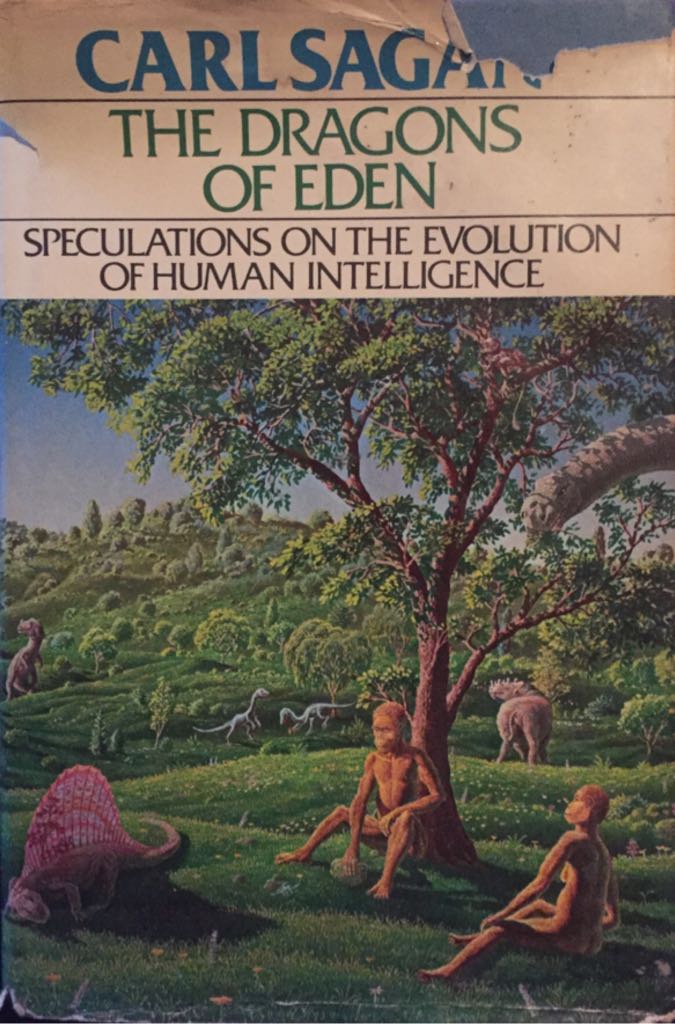
Dragons Of Eden, The
Genre:
Popular Culture
Science
Show More
Binding:
Hardcover
Edition:
2nd
Narrative:
First Person
Type of Book:
Non-Fiction
Number of Pages:
263
Number of Chapters:
9
Date Added:
2018-06-26 18:01:41
Synopsis:
The one barrier to this being a five star book is perhaps, by Sagan’s own admission, his lack of expertise in this field, which always makes a reader more skeptical, even if he has done the reading, provided an extensive bibliography and is obviously passionate and articulate on the subject at hand.
Some of the information may be a little dated, and in retrospect, while he claimed Bronowski a little anthropocentric in his disregard for the significance of chimp signing, sometimes he comes across as all too enthusiastic and seems a little anecdotal in his case for chimp linguistics, although there is no doubt that Washoe did sign in the Gardners’ program, which he covers in some detail.
Of particular interest to me was the discussion of human brain evolution from Australopithecus Africanus onwards, and how each species’ brain was an improvement on the old, to the detriment of our cousins within the genus.
The many evolutionary steps necessary to become better hunters and tool-makers are described succintly and with a clear idea of how each adaptation builds up a picture of modern humans; the way primates are scared of snakes from birth (the oft mentioned dragons), the function of dreaming in primates and higher mammals and the relationship of wide hips to big brains in humans; a woman with wider hips can give birth to babies with larger brains, so all size zero women are asking for stupid babies, which is quite apt. I have read that there was no actual ’informant’ involved with his writings on marijuana, and that research was first hand. Some of the material on the triune brain is covered in an episode of Cosmos, and I’m sure this book fed into the research for the series. Sagan seemed as interested in the phenomenon of intelligence as he was planetary science, and later science education and critical thinking along with his wife, Ann Druyan.
I think the last chapter is perhaps the most interesting, as it deals with the future of our species and possibilities for Extraterrestrial intelligence, the latter of which I might have wanted more of.
He hits upon something I had noticed quite independently; the tendency for Britain to produce a larger number of polymaths than other countries, and cited some of my other intellectual heroes; Bertrand Russell, A.N. Whitehead, J.B.S. Haldane and Jacob Bronowski (I would’ve added Peter Medawar as well). He wrote that it was important for society to allow for such broad and powerful thinkers - multi-disciplinarians, but that the evidence shows a steep ’decline’ towards specialisation. I can see this borne out across various media - there is scant evidence of polymaths living in the UK today.
I would recommend this book for anybody interested in gaining a thinking layman’s idea of neurophysiology and the evolution of the brain, and how human and animal intelligence relate to each other. Anybody looking for more authoritative and specialist works on neurobiology and evolutionary psychology might not find this as helpful, as it is speculative, although you can’t deny Sagan is gifted, perhaps as much as any scientist-author, in crafting such illuminating and lucid prose.
Definitely worth reading, even if you’re also looking for something along the lines of Oliver Sacks and Steven Pinker who have backgrounds in the fields discussed.
Some of the information may be a little dated, and in retrospect, while he claimed Bronowski a little anthropocentric in his disregard for the significance of chimp signing, sometimes he comes across as all too enthusiastic and seems a little anecdotal in his case for chimp linguistics, although there is no doubt that Washoe did sign in the Gardners’ program, which he covers in some detail.
Of particular interest to me was the discussion of human brain evolution from Australopithecus Africanus onwards, and how each species’ brain was an improvement on the old, to the detriment of our cousins within the genus.
The many evolutionary steps necessary to become better hunters and tool-makers are described succintly and with a clear idea of how each adaptation builds up a picture of modern humans; the way primates are scared of snakes from birth (the oft mentioned dragons), the function of dreaming in primates and higher mammals and the relationship of wide hips to big brains in humans; a woman with wider hips can give birth to babies with larger brains, so all size zero women are asking for stupid babies, which is quite apt. I have read that there was no actual ’informant’ involved with his writings on marijuana, and that research was first hand. Some of the material on the triune brain is covered in an episode of Cosmos, and I’m sure this book fed into the research for the series. Sagan seemed as interested in the phenomenon of intelligence as he was planetary science, and later science education and critical thinking along with his wife, Ann Druyan.
I think the last chapter is perhaps the most interesting, as it deals with the future of our species and possibilities for Extraterrestrial intelligence, the latter of which I might have wanted more of.
He hits upon something I had noticed quite independently; the tendency for Britain to produce a larger number of polymaths than other countries, and cited some of my other intellectual heroes; Bertrand Russell, A.N. Whitehead, J.B.S. Haldane and Jacob Bronowski (I would’ve added Peter Medawar as well). He wrote that it was important for society to allow for such broad and powerful thinkers - multi-disciplinarians, but that the evidence shows a steep ’decline’ towards specialisation. I can see this borne out across various media - there is scant evidence of polymaths living in the UK today.
I would recommend this book for anybody interested in gaining a thinking layman’s idea of neurophysiology and the evolution of the brain, and how human and animal intelligence relate to each other. Anybody looking for more authoritative and specialist works on neurobiology and evolutionary psychology might not find this as helpful, as it is speculative, although you can’t deny Sagan is gifted, perhaps as much as any scientist-author, in crafting such illuminating and lucid prose.
Definitely worth reading, even if you’re also looking for something along the lines of Oliver Sacks and Steven Pinker who have backgrounds in the fields discussed.
Author:
Carl Sagan
Show More
Publisher:
Book Club Associates
Place of Printing:
Thetford, Norfolk, England
Publication Date:
1977-06-01
Photos By:
Various
Show More
Number of Copies:
1
Language:
English
Publisher Location:
London, England.
Date Added:
2018-06-26 18:01:41