Title:
2018 NZ Annual Commemorative - Moa Silver Proof Coin
Description:
Moa are classified as part of the ratite group of birds, along with the emu, ostrich and kiwi. As they evolved in isolation from the rest of the world, and essentially without predators, the name of the living ratite to which they were more closely related has long been debated. For a long time it was thought to be the kiwi, but DNA testing has shown that the moa were most closely related to the small tinamous of South America - a surprising result indeed.
Highlights
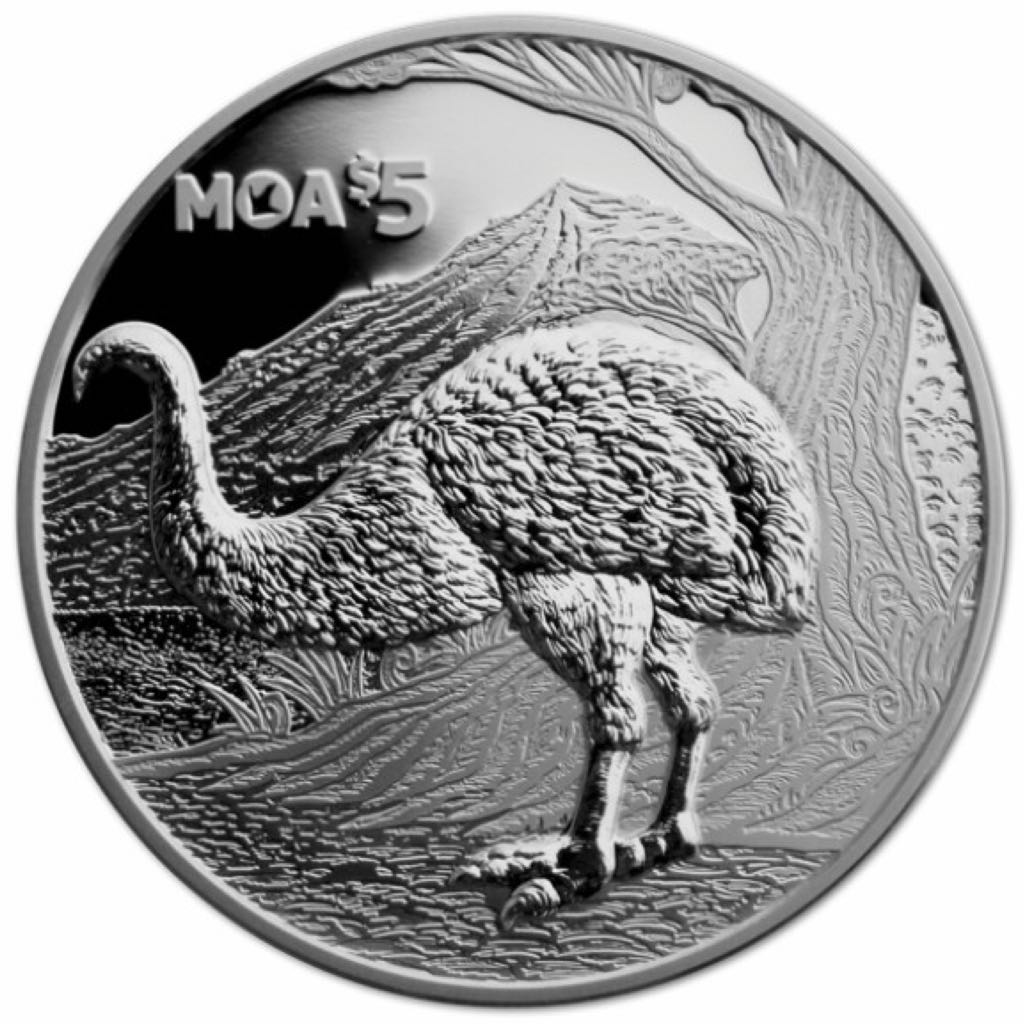
Features a stylised image of the extinct moa in three-dimensional relief
Low worldwide mintage of just 1,500 coins
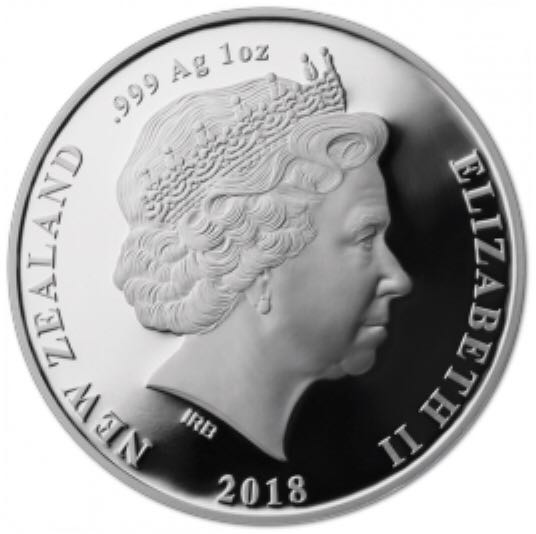
Minted from 0.999 silver
The only $5 coin to be issued each year
Designed by renowned New Zealand artist Dave Burke.
Design
These giant herbivores were prevalent across New Zealand’s mainland as well as on offshore islands such Great Barrier and Stewart. On coastal dunes, in swamp lands and dense forests and all the way up to sub-alpine zones around 2,000 metres above sea level, moa browsed on a wide variety of foliage including flowers, trees and berries.
This 1oz silver proof coin minted from 0.999 silver has a stylised image of a moa in one of its more common habitats. It’s thought that multiple species of moa would have shared similar regions and browsing areas. Here the moa is depicted in a southern landscape; snow-capped peaks in the background can be seen as it emerges from dense native bush.
It was a bird, but not a bird as you might know it: it had no wings; it could weigh more than 250 kilograms; and it could reach more than three metres in height!
Extinct for the past 700 years, moa were found only in New Zealand and were the only birds in the world to have no traces of wings. Comprising nine species, they belonged to the ’Dinornithiformes’ order and were traditionally placed in the ’ratite’ group with other flightless birds such as the ostrich, emu and kiwi. However, research has shown that the moa’s closest relatives were actually the primitive and chicken-like tinamous of South America.
While all moa were large birds, their weights and heights varied according to species and sex - females were larger than males - and generally increased the further south they were found. The smallest was Mantell’s moa (Pachyornis geranoides) in the north of the North Island, which weighed 15 to 20 kilograms and was a little larger than a turkey. In contrast, the south Island giant moa (Dinornis robustus) could weigh up to six times more than an emu, and with its neck outstretched could reach 3.6 metres, making it the tallest bird ever seen on our planet.
Moa generally fed on herbs and shrubs, but there were substantial differences in the species’ diets. Together with their varied sizes, these enabled three or four species to live together, while their wide range of habitats - from sub-alpine zones to lowland rain forests - also contributed to their diversity.
This group of giant herbivorous birds has fascinated scientists ever since Englishman Richard Owen identified the first bones in the 1830s. Sadly, he never saw a live moa: all species had been hunted to extinction within 100 to 150 years of the arrival of Māori in about 1250AD. In the 1840s, when missionaries were recording Māori knowledge, few Māori new anything about them.
Today, moa are known around the world as an outstanding example of avian evolution on islands - and, at the same time, an example of human-driven avian extinction, with a whole order of extraordinary birds lost forever.
An etching-like technique was used by talented artist Dave Burke to create this unique and highly detailed scene.
Highlights
Features a stylised image of the extinct moa in three-dimensional relief
Low worldwide mintage of just 1,500 coins
Minted from 0.999 silver
The only $5 coin to be issued each year
Designed by renowned New Zealand artist Dave Burke.
Design
These giant herbivores were prevalent across New Zealand’s mainland as well as on offshore islands such Great Barrier and Stewart. On coastal dunes, in swamp lands and dense forests and all the way up to sub-alpine zones around 2,000 metres above sea level, moa browsed on a wide variety of foliage including flowers, trees and berries.
This 1oz silver proof coin minted from 0.999 silver has a stylised image of a moa in one of its more common habitats. It’s thought that multiple species of moa would have shared similar regions and browsing areas. Here the moa is depicted in a southern landscape; snow-capped peaks in the background can be seen as it emerges from dense native bush.
It was a bird, but not a bird as you might know it: it had no wings; it could weigh more than 250 kilograms; and it could reach more than three metres in height!
Extinct for the past 700 years, moa were found only in New Zealand and were the only birds in the world to have no traces of wings. Comprising nine species, they belonged to the ’Dinornithiformes’ order and were traditionally placed in the ’ratite’ group with other flightless birds such as the ostrich, emu and kiwi. However, research has shown that the moa’s closest relatives were actually the primitive and chicken-like tinamous of South America.
While all moa were large birds, their weights and heights varied according to species and sex - females were larger than males - and generally increased the further south they were found. The smallest was Mantell’s moa (Pachyornis geranoides) in the north of the North Island, which weighed 15 to 20 kilograms and was a little larger than a turkey. In contrast, the south Island giant moa (Dinornis robustus) could weigh up to six times more than an emu, and with its neck outstretched could reach 3.6 metres, making it the tallest bird ever seen on our planet.
Moa generally fed on herbs and shrubs, but there were substantial differences in the species’ diets. Together with their varied sizes, these enabled three or four species to live together, while their wide range of habitats - from sub-alpine zones to lowland rain forests - also contributed to their diversity.
This group of giant herbivorous birds has fascinated scientists ever since Englishman Richard Owen identified the first bones in the 1830s. Sadly, he never saw a live moa: all species had been hunted to extinction within 100 to 150 years of the arrival of Māori in about 1250AD. In the 1840s, when missionaries were recording Māori knowledge, few Māori new anything about them.
Today, moa are known around the world as an outstanding example of avian evolution on islands - and, at the same time, an example of human-driven avian extinction, with a whole order of extraordinary birds lost forever.
An etching-like technique was used by talented artist Dave Burke to create this unique and highly detailed scene.
Country:
New Zealand
Year:
2018
Mintage:
0685/1,500
Material:
Silver
Denomination:
$5.00
Weight:
1 oz
Diameter:
40 mm
Edge:
reeded
Designers:
Ian Rank-Broadley
Dave Burke
BH Mayer’s Kunstprägeanstalt GmbH
Show More
Date Added:
2018-06-08 16:57:35
Date Added:
2018-06-08 16:57:35