Title:
2021 NZ Annual Commemorative - Auckland Island Merganser Silver Proof Coin
Description:
Mergansers are fish-eating waterfowl. The Auckland Island merganser Mergus australis was first discovered in 1840 after two French corvettes arrived at the rarely visited islands. Over the following 60 years around 20 specimens were collected, and is thought there were probably no more than 30 breeding pairs at any one time. The last sighting was in 1902, and by 1910 the species was declared extinct, primarily due to predation by introduced mammals, and collecting for museums. Fossil evidence shows that a similar species once occurred around coasts and in inland waterways of New Zealand, but became extinct by 1500 AD, not long after the arrival of humans.
Highlights
- New Zealand’s first-ever 2oz silver coin with 38.6mm diameter
- Minted from 0.999 silver
- Low worldwide mintage of 500
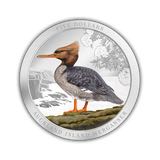
- Features the extinct Auckland Island merganser.
Design
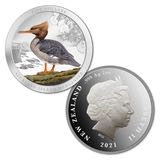
This stunning coin features a coloured illustration of the extinct Auckland Island merganser, inspired by the few specimens that exist today. The merganser stands in front of the steep cliffs of the Auckland Islands, and a southern rātā, a native tree with bright red flowers. This 2oz coin has been minted at a 38.6mm diameter, distinguishing it from other 2oz silver coins issued by New Zealand Post.
Home to some of the rarest birds in the world, the remote Auckland Islands sit 465 kilometres south of the New Zealand mainland. These are the largest of New Zealand’s subantarctic islands, made up of the remains of two ancient volcanoes broken apart by glaciers. Rich biodiversity has earned this collection of islands a reputation as the Galapagos of the Southern Ocean.
Mergansers are fish-eating waterfowl. The Auckland Island merganser Mergus australis was first discovered in 1840 after two French corvettes arrived at the rarely visited islands. In the following 60 years around 20 specimens were collected, and it is thought there were probably no more than 30 breeding pairs at any one time. The last sighting was in 1902, and by 1910 the species had been declared extinct, primarily due to predation by introduced mammals and collecting for museums. Fossil evidence shows that a similar species once existed around coasts and in inland waterways of New Zealand, but was extinct by
1500 AD, not long after the arrival of humans.
As is the story for most of New Zealand’s islands, intraduced animal pests have caused sometimes irreparable damage. However, rough weather and infertile soil have also meant permanent human habitation has not been possible. Archaeological evidence suggests the islands were visited, but only briefly occupied, by Polynesian navigators.
Chief Matiora of Ngāti Mutunga from the Chatham Islands led a settlement of Māori and Moriori there in 1842-56. While they were in residence, there was also a brief attempt at British settlement in 1849-52
The Department of Conservation is currently investigating whether it can achieve mammalian pest-free status for the New Zealand subantarctic islands by eradicating pigs, cats and mice from Auckland Istand. With no permanent human inhabitants, this UNESCO World Heritage site now stands as one of the last great protected wilderness areas on Earth.
Highlights
- New Zealand’s first-ever 2oz silver coin with 38.6mm diameter
- Minted from 0.999 silver
- Low worldwide mintage of 500
- Features the extinct Auckland Island merganser.
Design
This stunning coin features a coloured illustration of the extinct Auckland Island merganser, inspired by the few specimens that exist today. The merganser stands in front of the steep cliffs of the Auckland Islands, and a southern rātā, a native tree with bright red flowers. This 2oz coin has been minted at a 38.6mm diameter, distinguishing it from other 2oz silver coins issued by New Zealand Post.
Home to some of the rarest birds in the world, the remote Auckland Islands sit 465 kilometres south of the New Zealand mainland. These are the largest of New Zealand’s subantarctic islands, made up of the remains of two ancient volcanoes broken apart by glaciers. Rich biodiversity has earned this collection of islands a reputation as the Galapagos of the Southern Ocean.
Mergansers are fish-eating waterfowl. The Auckland Island merganser Mergus australis was first discovered in 1840 after two French corvettes arrived at the rarely visited islands. In the following 60 years around 20 specimens were collected, and it is thought there were probably no more than 30 breeding pairs at any one time. The last sighting was in 1902, and by 1910 the species had been declared extinct, primarily due to predation by introduced mammals and collecting for museums. Fossil evidence shows that a similar species once existed around coasts and in inland waterways of New Zealand, but was extinct by
1500 AD, not long after the arrival of humans.
As is the story for most of New Zealand’s islands, intraduced animal pests have caused sometimes irreparable damage. However, rough weather and infertile soil have also meant permanent human habitation has not been possible. Archaeological evidence suggests the islands were visited, but only briefly occupied, by Polynesian navigators.
Chief Matiora of Ngāti Mutunga from the Chatham Islands led a settlement of Māori and Moriori there in 1842-56. While they were in residence, there was also a brief attempt at British settlement in 1849-52
The Department of Conservation is currently investigating whether it can achieve mammalian pest-free status for the New Zealand subantarctic islands by eradicating pigs, cats and mice from Auckland Istand. With no permanent human inhabitants, this UNESCO World Heritage site now stands as one of the last great protected wilderness areas on Earth.
Country:
New Zealand
Year:
2021
Mintage:
112/500
Material:
Silver
Denomination:
$5.00
Weight:
2 oz
Diameter:
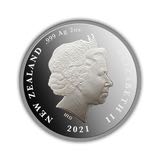
38.6 mm
Edge:
reeded
Designers:
Ian Rank-Broadley
Stephen Fuller
BH Mayer’s Kunstprägeanstalt GmbH
Show More
Date Added:
2021-05-28 09:09:34
Date Added:
2021-05-28 09:09:34