

Title:
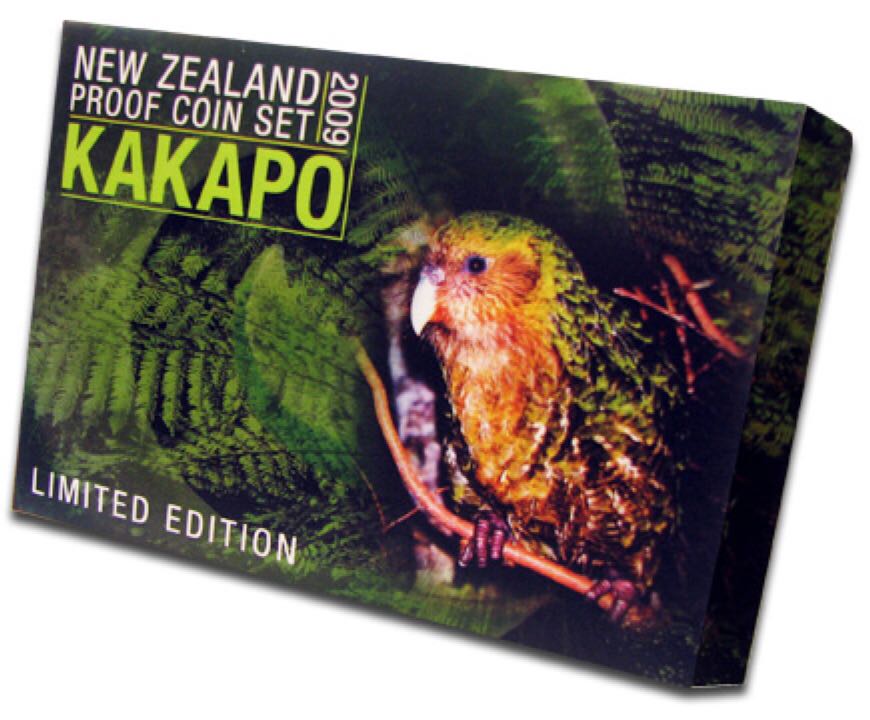
2009 NZ Proof Coin Set
Description:
This exquisite 2009 proof coin set celebrates New Zealand’s vibrantly coloured native kākāpō (Strigops habroptilus) - the world’s rarest parrot.
Lovingly designed in a contemporary style, the pure silver five-dollar feature coin depicts a stylised kakapo in a dynamic pose as it feeds on berries from a low-lying branch. The curve in the koru (spiral) shaped branch represents a new chance at life for this endangered bird with the success of conservation initiatives. This branch also highlights the unique tie the kakapo has with New Zealand.
Known as the ’parrot of the night’ by Māori, the nocturnal kākāpō is the only flightless parrot in the world. The kākāpō climbs using its strong legs and powerful claws. It has wings reduced in size which are used to help break the fall of this bird to its home on the forest floor.
Exclusively vegetarian, the kākāpō’s diet includes a wide variety of foliage of which the fruits of New Zealand’s native rimu tree are the favourite. These fruits are important in the survival of this stunning parrot as they breed only every three to five years when the rimu trees fruit heavily.
Unique to this special bird, the kākāpō uses a ’lek’ mating system. Usually a solitary bird, many males get together during their courting season to dig shallow depressions linked by tracks. From these ’bowls’ females are attracted through a variety of displays and by the males emitting a deep boom sound which can be heard by humans up to five kilometres away.
The kākāpō has strong cultural, spiritual and traditional links to New Zealand’s largest South Island Māori tribe, Ngāi Tahu. The kākāpō was an important source of food to local Māori in earlier times, and the bird’s mossy green and yellow feathers were used to make beautiful cloaks that have been cherished and handed down through generations of Ngāi Tahu.
The Kākāpō Recovery is a partnership between the Department of Conservation, the Royal Forest and Bird Protection Society of New Zealand, Comalco New Zealand and Rio Tinto Alcan New Zealand. It was established in 1990 in a bid to reduce the negative impact of introduced pests on the kākāpō population. It aims to manage (in consultation with Ngāi Tahu) the protection and breeding of these critically endangered birds, which are only found on offshore predator-free islands.
Thanks to this programme there were over 100 kăkãpo alive at the time of printing, an increase from only 51 in 1995.
Researchers are now optimistic that this native New Zealand bird species has a future.
$5 Kākāpō
$2 White Heron [Kotuku]
$1 Kiwi
50c HMS Endeavor
20c Pukaki [Maori Carving]
10c Koruru [Maori Carved Head]
Lovingly designed in a contemporary style, the pure silver five-dollar feature coin depicts a stylised kakapo in a dynamic pose as it feeds on berries from a low-lying branch. The curve in the koru (spiral) shaped branch represents a new chance at life for this endangered bird with the success of conservation initiatives. This branch also highlights the unique tie the kakapo has with New Zealand.
Known as the ’parrot of the night’ by Māori, the nocturnal kākāpō is the only flightless parrot in the world. The kākāpō climbs using its strong legs and powerful claws. It has wings reduced in size which are used to help break the fall of this bird to its home on the forest floor.
Exclusively vegetarian, the kākāpō’s diet includes a wide variety of foliage of which the fruits of New Zealand’s native rimu tree are the favourite. These fruits are important in the survival of this stunning parrot as they breed only every three to five years when the rimu trees fruit heavily.
Unique to this special bird, the kākāpō uses a ’lek’ mating system. Usually a solitary bird, many males get together during their courting season to dig shallow depressions linked by tracks. From these ’bowls’ females are attracted through a variety of displays and by the males emitting a deep boom sound which can be heard by humans up to five kilometres away.
The kākāpō has strong cultural, spiritual and traditional links to New Zealand’s largest South Island Māori tribe, Ngāi Tahu. The kākāpō was an important source of food to local Māori in earlier times, and the bird’s mossy green and yellow feathers were used to make beautiful cloaks that have been cherished and handed down through generations of Ngāi Tahu.
The Kākāpō Recovery is a partnership between the Department of Conservation, the Royal Forest and Bird Protection Society of New Zealand, Comalco New Zealand and Rio Tinto Alcan New Zealand. It was established in 1990 in a bid to reduce the negative impact of introduced pests on the kākāpō population. It aims to manage (in consultation with Ngāi Tahu) the protection and breeding of these critically endangered birds, which are only found on offshore predator-free islands.
Thanks to this programme there were over 100 kăkãpo alive at the time of printing, an increase from only 51 in 1995.
Researchers are now optimistic that this native New Zealand bird species has a future.
$5 Kākāpō
$2 White Heron [Kotuku]
$1 Kiwi
50c HMS Endeavor
20c Pukaki [Maori Carving]
10c Koruru [Maori Carved Head]
Country:
New Zealand
Year:
2009
Mintage:
0574/1,500
Material:
Silver
Denomination:
$0.00
Designers:
Perth Mint
Show More
Date Added:
2018-06-08 16:55:05
Date Added:
2018-06-08 16:55:05