Title:
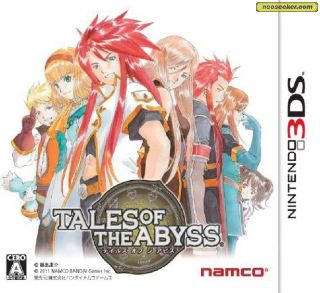
Tales Of The Abyss
Genre:
Action
Role Playing Game
Show More
Release Date:
1969-12-31
Date Added:
2018-07-03 12:37:44
Game Summary:
Tales of the Abyss (テイルズ オブ ジ アビス Teiruzu obu ji Abisu) is a role-playing video game developed by Namco Tales Studio and published by Namco in Japan and Namco Bandai Games in North America. Tales of the Abyss’s characteristic genre name is The Meaning Of Birth RPG (「生まれた意味を知るRPG」。). It is the eighth mothership title in the Tales series, and was released for the PlayStation 2 on December 15, 2005 in Japan, celebrating the Tales series’ 10th anniversary, and on October 10, 2006 in North America. It features the Flex Range Linear Motion Battle System, which most resembles Tales of Symphonia’s. The character designs are by manga artist Kōsuke Fujishima. The game was scheduled to receive a port to the Nintendo 3DS on May 19, 2011, but Namco Bandai has announced that the port for that region has been delayed to June 30, 2011. Nintendo Power magazine has confirmed the 3DS port for a North American release. It was released on February 14, 2012 in North America and in Europe on November 25, 2011.
An anime adaptation of the game, developed by Sunrise, premiered on MBS in October 2008. The episodes were directed by Kenji Kodama and written by Akemi Omode.
Gameplay
The game’s ”Flex Range Linear Motion Battle System” (FR-LMBS) is real-time. The game controls are very similar to other Tales games, especially Tales of Symphonia, except with increased maneuverability. The player can attack, defend, perform a skill or call up a menu with multiple functions, such as using items or commanding an ally to perform an action. This system offers multiplayer co-op battles, and the camera for this mode is improved over the one found in Tales of Symphonia, zooming out as characters move away from each other so that other players are now always on screen. A new feature, ”Free Run,” allows the player character to run in any direction, unlike previous Tales games.
The game features many skills and spells to unleash upon enemies. Characters can learn ”AD Skills,” which can be equipped and unequipped at will, to help them in battles. The game features a large number of these skills, acquired through the use of ”Capacity Cores” — items that give stat bonuses when a character levels up. Once a certain statistic has a large enough bonus, the AD skill is learned automatically. A new addition to the system is the ”Field of Fonons” (often abbreviated as FOF). Whenever a character uses a spell or battle technique that features an elemental alignment, a circle will appear on the ground, corresponding to that element. After being reinforced with more techniques of the same element, the circle will light up in that element’s color to signify that an FOF change is available. Finally, if a character stands in the circle and performs a specific skill that corresponds with the FOF circle, the skill will be upgraded into a more powerful version. Enemies can also use and create FOF fields. As with other Tales games, characters can engage in ”Over Limit” mode when their green OVL bar is full. This can be filled by completing combos and making critical hits. During Over Limit, characters can use their Mystic Artes (Hi-Ougis), powerful skills that can only be performed when certain conditions are fulfilled. Every character has one standard Mystic Arte, along with an additional hidden one unlockable only on repeat plays. Enemy boss characters have Mystic Artes as well.
Recurring features
Many recurring features in the Tales series return, such as skits, grade, cooking, and titles.
Skits are short conversations that may be viewed when prompted. During a skit, anime-style faces of the characters taking part in the skit appear and interact with each other. The characters in skits are animated, sometimes shaking, growing larger, or moving across the screen to accentuate what is happening in the skit. Skits can range from dramatic to comedic, and address a wide range of subjects. Some skits are related to the main plot, and some can only be obtained through optional side events. Unlike the Japanese version, the skits in the English version are not voiced.
”Grade” is awarded after each battle, either raising or lowering the player’s total number of points depending on how the battle was played. For example, defeating the enemies within a short period or time or getting a large combo will increase the grade awarded; characters being killed or having negative status effects on them will lower the grade acquired. At the end of the game, players can purchase bonuses for the next playthrough.
Abyss also features a cooking system. The player collects recipes and ingredients throughout the game, and can use them to cook either after battles or between battles. Unlike Tales of Symphonia, up to four different recipes can be set to the control pad for use after battle. Different recipes require different items and have different effects. The player can increase characters’ cooking stats for each recipe by having them cook the recipe frequently.
Abyss features titles which each character gains through a series of tasks or events. Titles have various effects, some of which are stat-related. In the tradition of newer Tales games, some of these titles also change costumes. Each character has unique costumes; to acquire additional costumes, the player must accomplish certain tasks. Unlike some other Tales games, every title in Tales of the Abyss carries a special effect, varying from discounts in shops to recovering small amounts of HP periodically.
Sorcerer’s ring
The sorcerer’s ring in Tales of the Abyss is an item that Mieu wears around his waist, and can be upgraded by the power of concentrated Fonons in certain dungeons to perform different helpful actions. These include Mieu Fire, where Mieu blows a ball of fire straight forward, used to activate switches and solve various puzzles; Mieu Attack, where Mieu is propelled forward to break objects and hit switches; and Mieu Wings, where Mieu flaps his ears and lifts the player characters into the air, useful for reaching high platforms and ladders.
Game economy
Various plot events alter the game’s economy, changing prices and item availability in shops; for instance, a shortage in the farming town of Engeve causes food prices to skyrocket, while the outbreak of war leads to a high variety equipment being sold at premium rates—and, consequently, higher profits when selling old gear.[citation needed] Furthermore, the player’s actions may alter the prices or even the availability of items available for sale.
North American PS2 exclusives
The North American version of Tales of the Abyss received extra features that are not present in the Japanese version. Guy, Natalia, Van and others gained new Mystic Artes. In addition to receiving a new Mystic Arte herself, Nebilim also gained the use of some of the playable characters’ Mystic Artes. Luke and Tear also received new Mystic Arte extensions. Although it is not an ”extra feature”, the Unknown difficulty for the North American release was modified to be a bit easier for players, with enemy stats multiplied by 3.5 rather than the original x4 in the Japanese version. These additions and alterations were carried over to the game’s Nintendo 3DS port.
Nintendo 3DS port
In September 2010, it was revealed at a Nintendo press conference that a port of the game would be coming to the Nintendo 3DS, with a planned release in 2011. The port will make use of the 3D and dual screen capabilities of the system, has new artwork designed by Kousuke Fujishima, and has a recolored logo, similar to the recoloring of Tales of Symphonia and Tales of Vesperia’s logos for their respective PlayStation 2 and PlayStation 3 ports. On April 5, 2011, Namco Bandai announced that the 3DS port for Japan had been delayed, but that more release information would be released when available. On April 27, 2011, magazine Nintendo Power has confirmed that the 3DS port will be making its way to North America. The game has been released in Europe for the first time as well.
Reception
Overall, reviews for the game have been positive, earning a 79% average on Game Rankings as of August 2008.
The game has been praised for its diverse cast with IGN particularly placing attention on the game’s protagonist and his ensuing character development. Others likewise praised the game’s dialogue and cut-scene direction, although some questioned both the overabundance of ”skits” which popped up from time to time as well as the localization team’s decision to omit the voice-acting that accompanied the skits in the Japanese version.
Most reviewers praised the battle system, stating that it was an improvement from earlier Tales installments while at the same time noting that it often devolved into ”mindless button mashing”. The graphics have received mixed attention. In particular, 1UP.com felt that they were ”rough around the edges” and GameSpot pointed out a drop in frame-rate on the world map, along with a generic mix of RPG locales.
Famitsu gave the title a (36/40) and ranked it at #44 in the publication’s 100 all-time favorite games list.
An anime adaptation of the game, developed by Sunrise, premiered on MBS in October 2008. The episodes were directed by Kenji Kodama and written by Akemi Omode.
Gameplay
The game’s ”Flex Range Linear Motion Battle System” (FR-LMBS) is real-time. The game controls are very similar to other Tales games, especially Tales of Symphonia, except with increased maneuverability. The player can attack, defend, perform a skill or call up a menu with multiple functions, such as using items or commanding an ally to perform an action. This system offers multiplayer co-op battles, and the camera for this mode is improved over the one found in Tales of Symphonia, zooming out as characters move away from each other so that other players are now always on screen. A new feature, ”Free Run,” allows the player character to run in any direction, unlike previous Tales games.
The game features many skills and spells to unleash upon enemies. Characters can learn ”AD Skills,” which can be equipped and unequipped at will, to help them in battles. The game features a large number of these skills, acquired through the use of ”Capacity Cores” — items that give stat bonuses when a character levels up. Once a certain statistic has a large enough bonus, the AD skill is learned automatically. A new addition to the system is the ”Field of Fonons” (often abbreviated as FOF). Whenever a character uses a spell or battle technique that features an elemental alignment, a circle will appear on the ground, corresponding to that element. After being reinforced with more techniques of the same element, the circle will light up in that element’s color to signify that an FOF change is available. Finally, if a character stands in the circle and performs a specific skill that corresponds with the FOF circle, the skill will be upgraded into a more powerful version. Enemies can also use and create FOF fields. As with other Tales games, characters can engage in ”Over Limit” mode when their green OVL bar is full. This can be filled by completing combos and making critical hits. During Over Limit, characters can use their Mystic Artes (Hi-Ougis), powerful skills that can only be performed when certain conditions are fulfilled. Every character has one standard Mystic Arte, along with an additional hidden one unlockable only on repeat plays. Enemy boss characters have Mystic Artes as well.
Recurring features
Many recurring features in the Tales series return, such as skits, grade, cooking, and titles.
Skits are short conversations that may be viewed when prompted. During a skit, anime-style faces of the characters taking part in the skit appear and interact with each other. The characters in skits are animated, sometimes shaking, growing larger, or moving across the screen to accentuate what is happening in the skit. Skits can range from dramatic to comedic, and address a wide range of subjects. Some skits are related to the main plot, and some can only be obtained through optional side events. Unlike the Japanese version, the skits in the English version are not voiced.
”Grade” is awarded after each battle, either raising or lowering the player’s total number of points depending on how the battle was played. For example, defeating the enemies within a short period or time or getting a large combo will increase the grade awarded; characters being killed or having negative status effects on them will lower the grade acquired. At the end of the game, players can purchase bonuses for the next playthrough.
Abyss also features a cooking system. The player collects recipes and ingredients throughout the game, and can use them to cook either after battles or between battles. Unlike Tales of Symphonia, up to four different recipes can be set to the control pad for use after battle. Different recipes require different items and have different effects. The player can increase characters’ cooking stats for each recipe by having them cook the recipe frequently.
Abyss features titles which each character gains through a series of tasks or events. Titles have various effects, some of which are stat-related. In the tradition of newer Tales games, some of these titles also change costumes. Each character has unique costumes; to acquire additional costumes, the player must accomplish certain tasks. Unlike some other Tales games, every title in Tales of the Abyss carries a special effect, varying from discounts in shops to recovering small amounts of HP periodically.
Sorcerer’s ring
The sorcerer’s ring in Tales of the Abyss is an item that Mieu wears around his waist, and can be upgraded by the power of concentrated Fonons in certain dungeons to perform different helpful actions. These include Mieu Fire, where Mieu blows a ball of fire straight forward, used to activate switches and solve various puzzles; Mieu Attack, where Mieu is propelled forward to break objects and hit switches; and Mieu Wings, where Mieu flaps his ears and lifts the player characters into the air, useful for reaching high platforms and ladders.
Game economy
Various plot events alter the game’s economy, changing prices and item availability in shops; for instance, a shortage in the farming town of Engeve causes food prices to skyrocket, while the outbreak of war leads to a high variety equipment being sold at premium rates—and, consequently, higher profits when selling old gear.[citation needed] Furthermore, the player’s actions may alter the prices or even the availability of items available for sale.
North American PS2 exclusives
The North American version of Tales of the Abyss received extra features that are not present in the Japanese version. Guy, Natalia, Van and others gained new Mystic Artes. In addition to receiving a new Mystic Arte herself, Nebilim also gained the use of some of the playable characters’ Mystic Artes. Luke and Tear also received new Mystic Arte extensions. Although it is not an ”extra feature”, the Unknown difficulty for the North American release was modified to be a bit easier for players, with enemy stats multiplied by 3.5 rather than the original x4 in the Japanese version. These additions and alterations were carried over to the game’s Nintendo 3DS port.
Nintendo 3DS port
In September 2010, it was revealed at a Nintendo press conference that a port of the game would be coming to the Nintendo 3DS, with a planned release in 2011. The port will make use of the 3D and dual screen capabilities of the system, has new artwork designed by Kousuke Fujishima, and has a recolored logo, similar to the recoloring of Tales of Symphonia and Tales of Vesperia’s logos for their respective PlayStation 2 and PlayStation 3 ports. On April 5, 2011, Namco Bandai announced that the 3DS port for Japan had been delayed, but that more release information would be released when available. On April 27, 2011, magazine Nintendo Power has confirmed that the 3DS port will be making its way to North America. The game has been released in Europe for the first time as well.
Reception
Overall, reviews for the game have been positive, earning a 79% average on Game Rankings as of August 2008.
The game has been praised for its diverse cast with IGN particularly placing attention on the game’s protagonist and his ensuing character development. Others likewise praised the game’s dialogue and cut-scene direction, although some questioned both the overabundance of ”skits” which popped up from time to time as well as the localization team’s decision to omit the voice-acting that accompanied the skits in the Japanese version.
Most reviewers praised the battle system, stating that it was an improvement from earlier Tales installments while at the same time noting that it often devolved into ”mindless button mashing”. The graphics have received mixed attention. In particular, 1UP.com felt that they were ”rough around the edges” and GameSpot pointed out a drop in frame-rate on the world map, along with a generic mix of RPG locales.
Famitsu gave the title a (36/40) and ranked it at #44 in the publication’s 100 all-time favorite games list.
Platform:
Nintendo 3DS
Developers:
Show More
Country of Purchase:
United States
Input Devices:
Show More
Automatic Estimated Value:
~$24.99
Automatic Estimated Date:
2025-05-26
Date Added:
2018-07-03 12:37:44