Title:
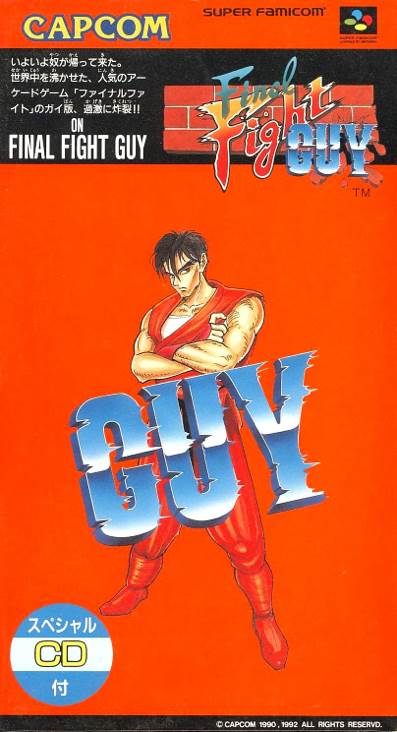
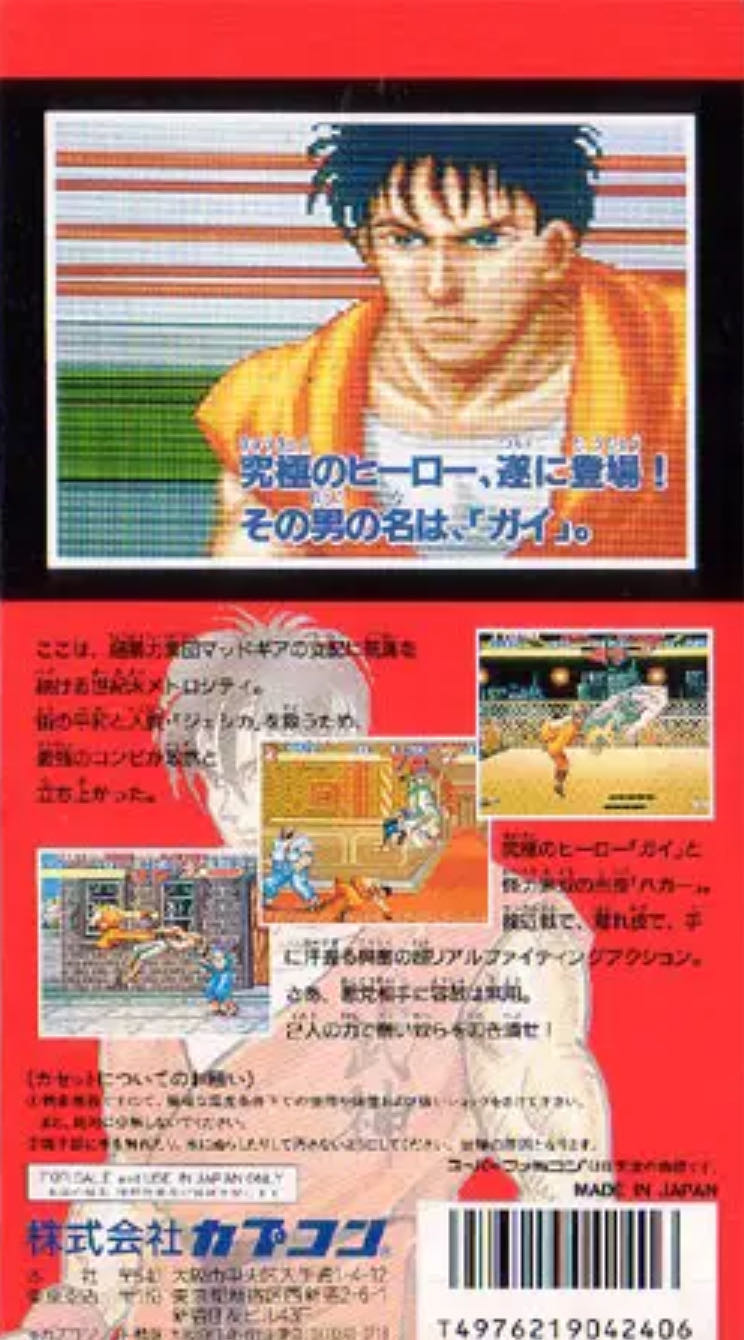
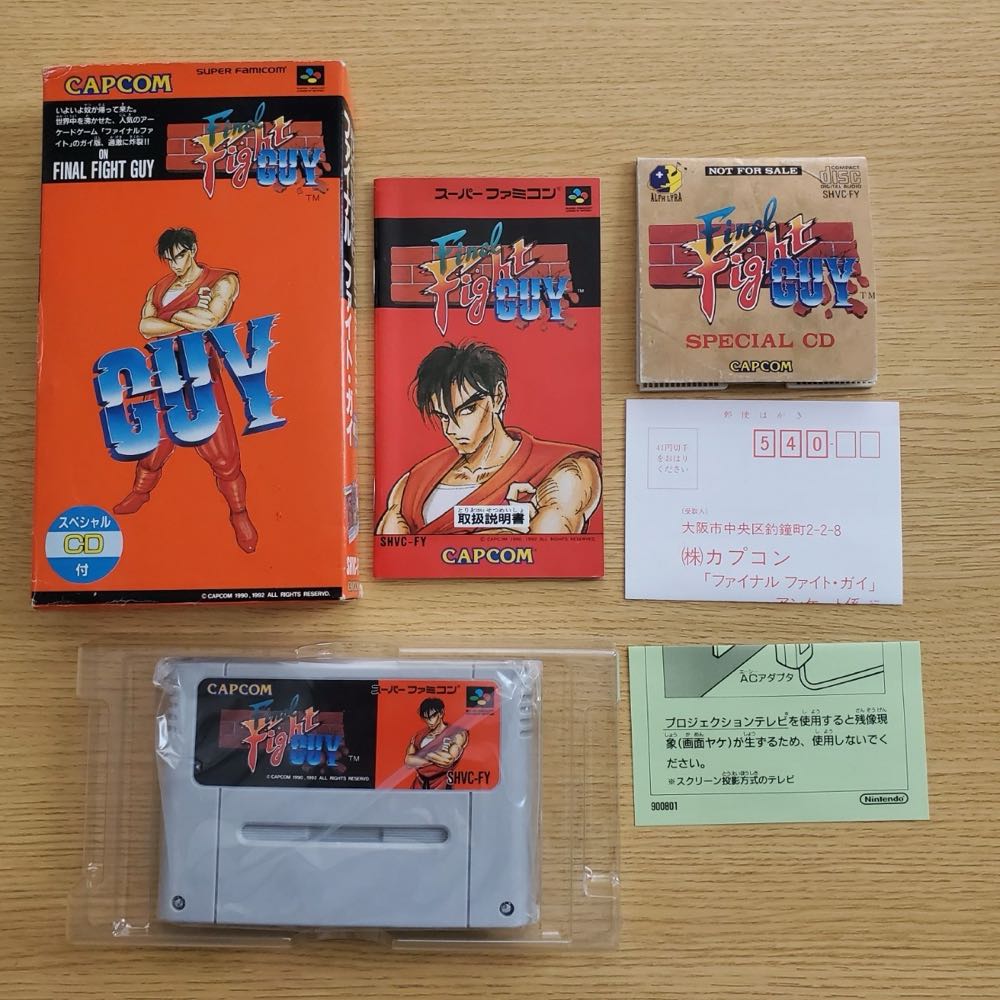
Final Fight Guy ファイナルファイト・ガイ
Series:
Final Fight
Series Order:
1
Rating:
B
Genre:
Action
Adventure
Side Scrolling
Arcade
Beat ’em Up (Brawler)
Show More
IGN Score:
10.0
Release Date:
1992-03-20
Date Added:
2018-07-03 13:54:37
Game Summary:
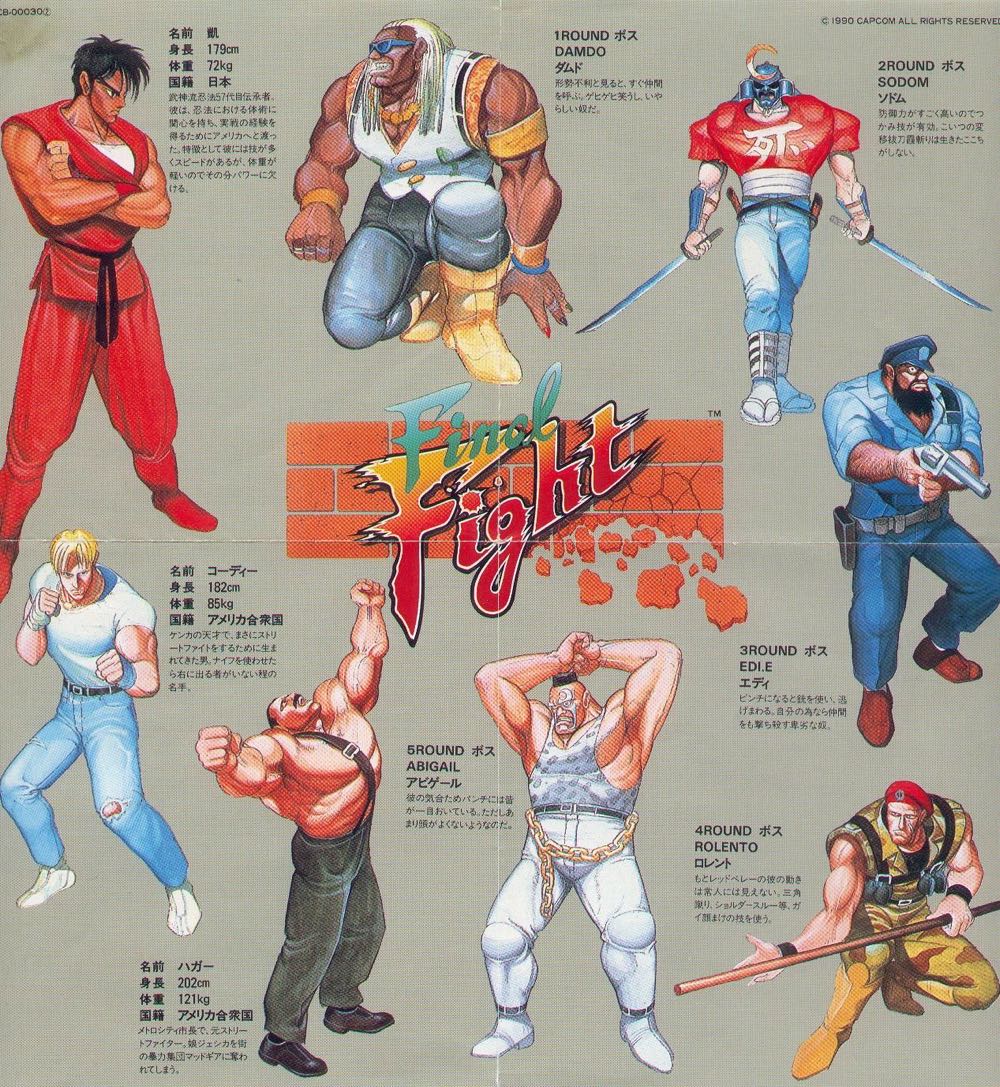
Final Fight is a side-scrolling beat-’em-up video game produced by Capcom. Originally released as an arcade game in 1989, it was the seventh title released for the CP System hardware. Set in the fictional Metro City, the game lets the player control one of three street fighters: former pro wrestler and city mayor Mike Haggar, expert brawler Cody Travers, and modern-day ninja Guy. The trio set out to rescue Jessica (Haggar’s daughter and Cody’s girlfriend) when she is kidnapped by the Mad Gear Gang.
The game began development as a sequel to the original Street Fighter released in 1987, under the working title Street Fighter ’89, but the genre was switched from a fighting game to a beat ’em up and the title was changed to Final Fight following the success of Double Dragon. Final Fight was ported to various home computers and consoles, including the ZX Spectrum, Super NES and Sega CD.
It became a major commercial success in arcades, selling 30,000 arcade units worldwide while becoming the highest-grossing arcade game of 1990 in Japan and the year’s highest-grossing arcade conversion kit in the United States. The Super NES version also sold 1.5 million cartridges worldwide. It spawned the Final Fight series, followed by several sequels. Its development team later worked on the original Street Fighter II, and some of the characters from Final Fight later appeared as playable fighters in other entries of the franchise, such as the Street Fighter Alpha sub-series.
Gameplay:
Final Fight can be played by up to two players simultaneously. Before the game begins, the player chooses between the three main characters: Haggar, Cody, and Guy. Each has his own fighting style and attributes. Health gauges are displayed for both player and enemy characters.
The controls for Final Fight consist of an eight-way joystick and two buttons for attacking and jumping respectively. Pressing the attack button repeatedly when attacking an enemy or multiple enemies will cause the player character to perform a combo. The final blow of the combo can be changed to a throw if the player moves the joystick in the opposite direction just before landing it. The player can also perform jump attacks. Pressing the attack and jump buttons simultaneously allows the player to perform a special attack that strikes all surrounding enemies, but will drain a small portion of the player’s health.
Enemies can be grabbed simply by walking into one of them. When an enemy is grabbed, the player can perform a grab attack by pressing the attack button or perform a throw by tilting the joystick left or right. A thrown enemy can be tossed at another for additional damage. Items such as weapons, health recovery items, and items awarding extra points can be picked up by standing over one and pressing the attack button. Weapons have limited uses and will disappear if the player is disarmed by an enemy too much or when the player moves to a new area.
Final Fight consists of six stages or ”rounds”, as well as two bonus rounds. Each round takes place in a different section of Metro City such as the Slums and the Subway, with most rounds featuring more than one level. At the end of each round the player will face a boss character unique to that round.
Plot:
The game is set in a fictional city on the Atlantic coast in the United States named Metro City (analogous with New York City). According to the game’s intro, in the 1990s (or 1989 in the Japanese version), the city’s crime rate reached alarming levels, but since the election of pro wrestler turned politician Mike Haggar as the new Mayor, Metro City was changed and cleaned up drastically. Under his term, Haggar managed to suppress the crime rate of the city to its lowest points. While the citizens of Metro City were thankful for Haggar’s hard work in curbing crime, the Mad Gear Gang, who had served as the dominant criminal organization of Metro City, would not go down so easily. Under the leadership of the crooked businessman Belger, the group attempted to bribe Haggar with a large payoff to keep him from going after them, to which Haggar refused. Still determined to bring Haggar under their rule like the last mayor before him, Mad Gear proceeded to kidnap his daughter Jessica and create further unrest among the citizens. When Haggar finds out about his daughter’s abduction, he becomes furious and decides to take his fight against Mad Gear to a personal level. Seeking additional manpower, Haggar recruits Cody Travers: an expert fighter and Jessica’s boyfriend, as well as Guy: a ninja in training and Cody’s good friend/rival. The three dedicate themselves to the complete eradication of the Mad Gear Gang, and to rescue Jessica from their clutches.
The game gained notoriety for its unique continue screen, where the player character is shown tied to a chair with a bundle of dynamite on the table in front of him; the character struggles to escape as the 10-second time limit counts down. If the player activates the continue option, a knife falls from the ceiling, disconnecting the fuse from the bomb.
Home versions:
• Super NES (Final Fight and Final Fight Guy)
A port of Final Fight for the Super Nintendo Entertainment System was released as a launch title for the platform in Japan in 1990 and later in North America in 1991 and then in the PAL region in 1992. It was released for the Wii’s Virtual Console service in 2007 and the Wii U’s Virtual Console in 2013. The SNES port removed the two-player co-op option, the Industrial Area level and playable character Guy. Most of the scene transitions were also edited out. In the arcade version, the player characters would be seen exiting the levels and breaking through doors unlike the SNES version. Due to hardware limitations the SNES version could only display two or three enemies on-screen, in contrast to the CPS arcade version, which could display up to nine or ten enemies on-screen; to make up for this difference, the SNES version features more stopping points than the arcade version and the enemy placement is vastly different.
The English localization of the SNES port was censored for its content and features several differences from its Japanese Super Famicom counterpart: the first two bosses, Damnd and Sodom, were renamed Thrasher and Katana, respectively; Belger’s wheelchair was re-drawn to look like an office chair; Poison, a woman with pink hair, and Roxy, a woman with red hair, were replaced with two male enemies named Billy and Sid; all alcoholic references were removed, with two health-recovering items replaced; the line ”Oh! My God”, spoken by an enemy when his car is destroyed during the first bonus stage, was changed to ”Oh! My Car”; the blood splash effect shown when a character is stabbed was replaced by a generic explosion; and some of the darker skinned enemy characters were given lighter skin tones. The original soundtrack was ported for the Super NES by Toshio Kajino (credited as ”Bull”).
A revised edition of the SNES port, titled Final Fight Guy, was released in Japan in 1992. This version replaced Cody with Guy as a selectable character (with a new opening and ending sequence explaining Cody’s absence), included four difficulty settings, and added other new features such as two new power-ups, although the Industrial Area stage and the two-player mode were still omitted. An American version of the game (featuring the same changes in the localization as in the first game) was released in June 1994 as a rental-only game that was initially available at Blockbuster stores, although it was later given a limited release. Kajino’s music port was retained for that version.
• Mega-CD/Sega CD (Final Fight CD)
The Mega-CD/Sega CD version, titled Final Fight CD, was ported by A Wave and published by Sega under license from Capcom in 1993. This version retains nearly all the features of the arcade game that were removed in the two SNES ports (namely the two-player mode, the Industrial Area stage and the ability to play as any of the three main characters) and adds voice acting to the game’s opening and ending sequences, an arranged version of the original soundtrack, and an exclusive time attack mode. However the maximum number of on-screen enemies were still lower than the arcade version and the combo attacks of Cody and Guy are much slower. Furthermore, the graphics suffered from a more limited color palette, as well as fewer background details. Like the SNES version, the Mega-CD version was censored for the English localization with many of the same changes. Poison and Roxy were kept, but were redrawn with less revealing clothing.
• Game Boy Advance (Final Fight One)
The Game Boy Advance version that was developed by Sun-Tec, titled Final Fight One, was released in 2001. Final Fight One features all three characters and the Industrial Area stage that was missing from the SNES version. The two-player cooperative mode is also featured via link cable. Dialogue scenes prior to each boss battle have been added and the Street Fighter Alpha 3 renditions of Cody and Guy are featured as hidden playable characters. Other unlockable features include alternate palettes for each player character and the ability for two players to use the same character. The character and background designs are lifted from the SNES versions rather than the original arcade version, with the enemy placement being similar to Final Fight Guy, although the maximum number of on-screen enemies was increased and all the transition sequences were restored. The same new power-up items introduced in Final Fight Guy are also present in this version, along with a new Cody doll item. The English localization of the game featured the same changes as the two SNES versions.
The game began development as a sequel to the original Street Fighter released in 1987, under the working title Street Fighter ’89, but the genre was switched from a fighting game to a beat ’em up and the title was changed to Final Fight following the success of Double Dragon. Final Fight was ported to various home computers and consoles, including the ZX Spectrum, Super NES and Sega CD.
It became a major commercial success in arcades, selling 30,000 arcade units worldwide while becoming the highest-grossing arcade game of 1990 in Japan and the year’s highest-grossing arcade conversion kit in the United States. The Super NES version also sold 1.5 million cartridges worldwide. It spawned the Final Fight series, followed by several sequels. Its development team later worked on the original Street Fighter II, and some of the characters from Final Fight later appeared as playable fighters in other entries of the franchise, such as the Street Fighter Alpha sub-series.
Gameplay:
Final Fight can be played by up to two players simultaneously. Before the game begins, the player chooses between the three main characters: Haggar, Cody, and Guy. Each has his own fighting style and attributes. Health gauges are displayed for both player and enemy characters.
The controls for Final Fight consist of an eight-way joystick and two buttons for attacking and jumping respectively. Pressing the attack button repeatedly when attacking an enemy or multiple enemies will cause the player character to perform a combo. The final blow of the combo can be changed to a throw if the player moves the joystick in the opposite direction just before landing it. The player can also perform jump attacks. Pressing the attack and jump buttons simultaneously allows the player to perform a special attack that strikes all surrounding enemies, but will drain a small portion of the player’s health.
Enemies can be grabbed simply by walking into one of them. When an enemy is grabbed, the player can perform a grab attack by pressing the attack button or perform a throw by tilting the joystick left or right. A thrown enemy can be tossed at another for additional damage. Items such as weapons, health recovery items, and items awarding extra points can be picked up by standing over one and pressing the attack button. Weapons have limited uses and will disappear if the player is disarmed by an enemy too much or when the player moves to a new area.
Final Fight consists of six stages or ”rounds”, as well as two bonus rounds. Each round takes place in a different section of Metro City such as the Slums and the Subway, with most rounds featuring more than one level. At the end of each round the player will face a boss character unique to that round.
Plot:
The game is set in a fictional city on the Atlantic coast in the United States named Metro City (analogous with New York City). According to the game’s intro, in the 1990s (or 1989 in the Japanese version), the city’s crime rate reached alarming levels, but since the election of pro wrestler turned politician Mike Haggar as the new Mayor, Metro City was changed and cleaned up drastically. Under his term, Haggar managed to suppress the crime rate of the city to its lowest points. While the citizens of Metro City were thankful for Haggar’s hard work in curbing crime, the Mad Gear Gang, who had served as the dominant criminal organization of Metro City, would not go down so easily. Under the leadership of the crooked businessman Belger, the group attempted to bribe Haggar with a large payoff to keep him from going after them, to which Haggar refused. Still determined to bring Haggar under their rule like the last mayor before him, Mad Gear proceeded to kidnap his daughter Jessica and create further unrest among the citizens. When Haggar finds out about his daughter’s abduction, he becomes furious and decides to take his fight against Mad Gear to a personal level. Seeking additional manpower, Haggar recruits Cody Travers: an expert fighter and Jessica’s boyfriend, as well as Guy: a ninja in training and Cody’s good friend/rival. The three dedicate themselves to the complete eradication of the Mad Gear Gang, and to rescue Jessica from their clutches.
The game gained notoriety for its unique continue screen, where the player character is shown tied to a chair with a bundle of dynamite on the table in front of him; the character struggles to escape as the 10-second time limit counts down. If the player activates the continue option, a knife falls from the ceiling, disconnecting the fuse from the bomb.
Home versions:
• Super NES (Final Fight and Final Fight Guy)
A port of Final Fight for the Super Nintendo Entertainment System was released as a launch title for the platform in Japan in 1990 and later in North America in 1991 and then in the PAL region in 1992. It was released for the Wii’s Virtual Console service in 2007 and the Wii U’s Virtual Console in 2013. The SNES port removed the two-player co-op option, the Industrial Area level and playable character Guy. Most of the scene transitions were also edited out. In the arcade version, the player characters would be seen exiting the levels and breaking through doors unlike the SNES version. Due to hardware limitations the SNES version could only display two or three enemies on-screen, in contrast to the CPS arcade version, which could display up to nine or ten enemies on-screen; to make up for this difference, the SNES version features more stopping points than the arcade version and the enemy placement is vastly different.
The English localization of the SNES port was censored for its content and features several differences from its Japanese Super Famicom counterpart: the first two bosses, Damnd and Sodom, were renamed Thrasher and Katana, respectively; Belger’s wheelchair was re-drawn to look like an office chair; Poison, a woman with pink hair, and Roxy, a woman with red hair, were replaced with two male enemies named Billy and Sid; all alcoholic references were removed, with two health-recovering items replaced; the line ”Oh! My God”, spoken by an enemy when his car is destroyed during the first bonus stage, was changed to ”Oh! My Car”; the blood splash effect shown when a character is stabbed was replaced by a generic explosion; and some of the darker skinned enemy characters were given lighter skin tones. The original soundtrack was ported for the Super NES by Toshio Kajino (credited as ”Bull”).
A revised edition of the SNES port, titled Final Fight Guy, was released in Japan in 1992. This version replaced Cody with Guy as a selectable character (with a new opening and ending sequence explaining Cody’s absence), included four difficulty settings, and added other new features such as two new power-ups, although the Industrial Area stage and the two-player mode were still omitted. An American version of the game (featuring the same changes in the localization as in the first game) was released in June 1994 as a rental-only game that was initially available at Blockbuster stores, although it was later given a limited release. Kajino’s music port was retained for that version.
• Mega-CD/Sega CD (Final Fight CD)
The Mega-CD/Sega CD version, titled Final Fight CD, was ported by A Wave and published by Sega under license from Capcom in 1993. This version retains nearly all the features of the arcade game that were removed in the two SNES ports (namely the two-player mode, the Industrial Area stage and the ability to play as any of the three main characters) and adds voice acting to the game’s opening and ending sequences, an arranged version of the original soundtrack, and an exclusive time attack mode. However the maximum number of on-screen enemies were still lower than the arcade version and the combo attacks of Cody and Guy are much slower. Furthermore, the graphics suffered from a more limited color palette, as well as fewer background details. Like the SNES version, the Mega-CD version was censored for the English localization with many of the same changes. Poison and Roxy were kept, but were redrawn with less revealing clothing.
• Game Boy Advance (Final Fight One)
The Game Boy Advance version that was developed by Sun-Tec, titled Final Fight One, was released in 2001. Final Fight One features all three characters and the Industrial Area stage that was missing from the SNES version. The two-player cooperative mode is also featured via link cable. Dialogue scenes prior to each boss battle have been added and the Street Fighter Alpha 3 renditions of Cody and Guy are featured as hidden playable characters. Other unlockable features include alternate palettes for each player character and the ability for two players to use the same character. The character and background designs are lifted from the SNES versions rather than the original arcade version, with the enemy placement being similar to Final Fight Guy, although the maximum number of on-screen enemies was increased and all the transition sequences were restored. The same new power-up items introduced in Final Fight Guy are also present in this version, along with a new Cody doll item. The English localization of the game featured the same changes as the two SNES versions.
Platform:
Nintendo Super Famicom
Publisher:
Capcom
Developers:
Capcom
Show More
Players:
1
Country of Purchase:
Japan
Graphics:
16-bit
Input Devices:
Controller Game Pad
Arcade Gamepad
Show More
Media Type:
Cartridge
Game Modes:
Single Player
Show More
Packaging:
Cardboard Box
Automatic Estimated Value:
~$29.93
Automatic Estimated Date:
2025-08-10
Date Added:
2018-07-03 13:54:37