Title:
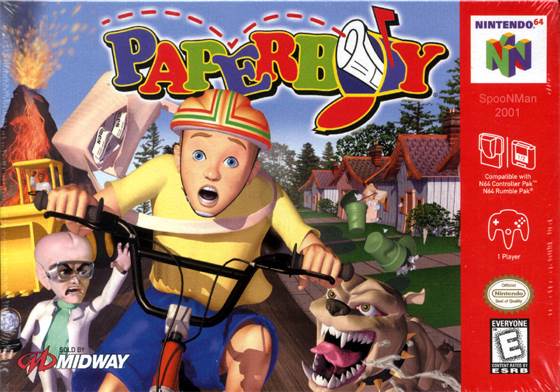
Paperboy 64
Series:
Paperboy
Series Order:
3
Rating:
E
Genre:
Action
Adventure
Strategy
Arcade
Show More
IGN Score:
5.0
Release Date:
1999-11-04
Date Added:
2018-07-03 14:55:08
Game Summary:
Paperboy is an arcade action game developed and published by Atari Games, and released in 1985. The player takes the role of a paperboy who delivers a fictional newspaper called The Daily Sun along a street on his bicycle. The arcade version of the game featured bike handlebars as the controller.
The game was ported to many home systems beginning in 1986. A sequel for home computers and consoles, Paperboy 2, was released in 1991.
Description:
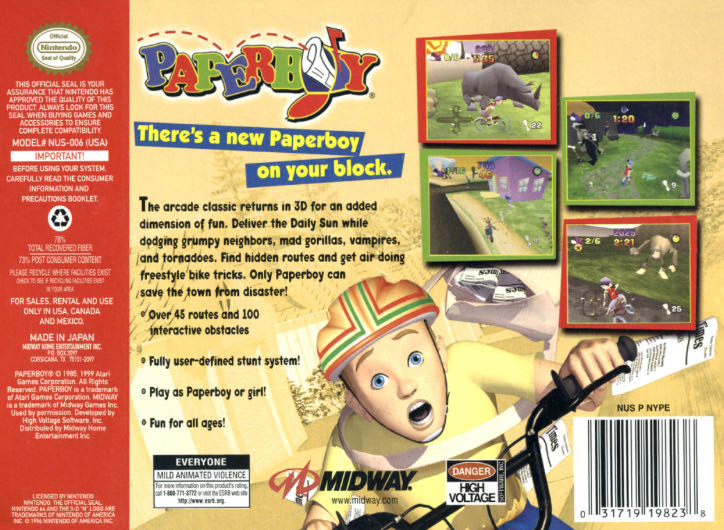
There’s a new Paperboy on the block.
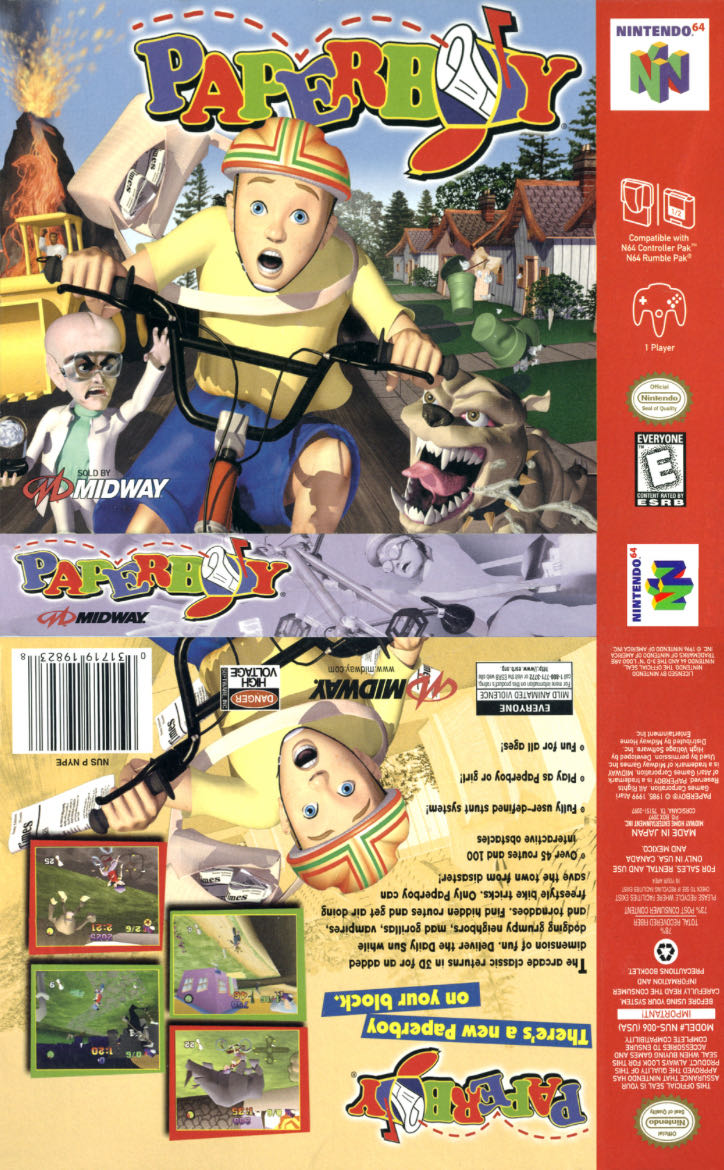
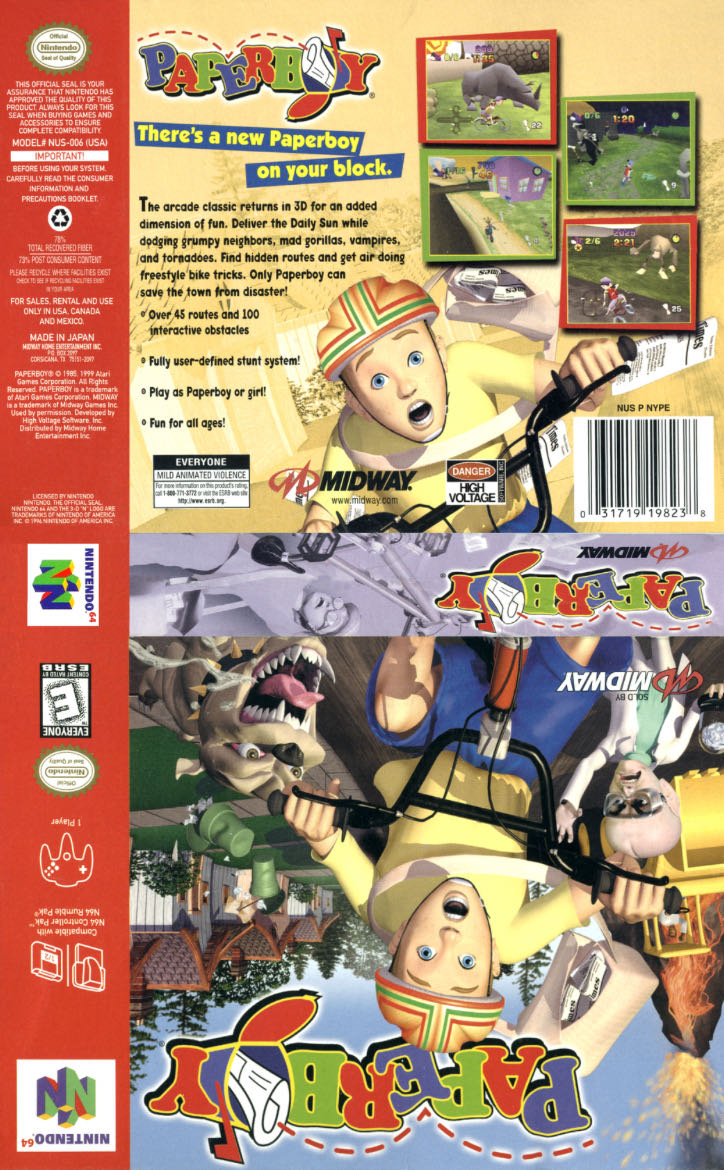
There’s a new Paperboy on your block! The arcade classic returns in 3D for an added dimension of fun. Deliver the Daily Sun while dodging grumpy neighbors, mad gorillas, vampires, and tornadoes. Find hidden routes and get air doing freestyle bike tricks. Only Paperboy can save the town from disaster!
Featuring:
• Over 45 routes and 100 interactive obstacles
• Fully user-defined stunt system!
• Play as a Paperboy or girl!
• Fun for all ages!
Gameplay:
The player controls a paperboy on a bicycle delivering newspapers along a suburban street which is displayed in a cabinet perspective (or oblique projection) view. The player attempts to deliver a week of daily newspapers to subscribing customers, attempts to vandalize non-subscribers’ homes and must avoid hazards along the street. Subscribers are lost by missing a delivery or damaging a subscriber’s house. If the player loses all of their lives, or runs out of subscribers, the game ends.
The game begins with a choice of difficulty levels: Easy Street, Middle Road and Hard Way. The object of the game is to perfectly deliver papers to subscribers for an entire week and avoid crashing (which counts as one of the player’s lives) before the week ends. The game lasts for seven in-game days, Monday through Sunday.
Controlling the paperboy with the handlebar controls, the player attempts to deliver newspapers to subscribers. Each day begins by showing an overview of the street indicating subscribers and non-subscribers. Subscribers and non-subscribers’ homes are easy to discern in the level itself, with subscribers living in brightly colored houses, and non-subscribers living in dark houses.
The player scores points for each paper delivered successfully, either at a subscriber’s doorstep or inside their mailbox, the latter of which awards more points, as well as breakage points by damaging the houses of non-subscribers. A perfect delivery, with all subscribers get their papers, and none of their houses are damaged, results in all the points being worth double for that day, and an extra subscriber is added. At the end of each stage is a training course with various obstacles to throw papers at which gives bonus points and to jump over, and the player scores a bonus for finishing the course. Crashing on the course ends the round, but does not cost the player a life.
When a player fails to deliver a paper to a house, or damages a subscriber’s house by breaking their windows, the resident will cancel their subscription, and the house turns dark. The player can regain subscribers by getting a perfect delivery, which adds one extra subscriber.[citation needed]
The paperboy can hold no more than ten papers at once, although refills can be found throughout the level. The papers can be used to stun enemies, with the exception of cars.[citation needed]
Development:
Hop on your bike for a free-wheeling ride up the avenues of not-so-typical suburbia. There are papers to be delivered, robbers to be foiled, and fame and fortune to be won as you brave the mean streets. Avoid motorcycles, tricycles, traffic, tires, gratings, curbs, dogs, skateboarders, breakdancers, bad guys, and other hazards as you deliver to your customers. Earn bonus points by hitting targets along the obstacle course at the end of your route.
The cabinet is a standard upright but with custom controls. The controls consist of a bicycle handlebar (a modified Star Wars yoke) with one button on each side, used to throw papers. The handlebars can be pushed forward to accelerate and pulled back to brake.
The game runs on the Atari System 2 hardware. The CPU is a 10 MHz Digital Equipment Corporation (DEC) T-11. For sound and coin inputs, it uses a 2.2 MHz MOS Technology 6502. The sound chips are two POKEYs for digital sound, a Yamaha YM2151 for music, and a Texas Instruments TMS5220 for speech. The protection chip is a Slapstic model 137412-105.
The game program code for the arcade version was written in BLISS.
Ports:
Elite Systems produced a version for the ZX Spectrum which was released in the United Kingdom in September 1986, and went on to release versions for the Commodore 64, BBC Micro, Acorn Electron, Amstrad CPC, Commodore 16 and Commodore Plus/4 over the following months.
A version for the Apple IIGS was released in 1988. In the United States, a Nintendo Entertainment System (NES) version was developed by Eastridge Technology and published by Mindscape in December 1988. Coverage of the NES version abruptly began at the Summer CES 1988 as a last-minute replacement for a port of the computer title Bad Street Brawler, which was about to be ported to the NES. In October 1989, Elite released versions for the Atari ST and PC in the United Kingdom, followed by an Amiga version later that month. The game was released for the Famicom by Altron in January 1991.
In the United Kingdom, a Game Boy version by Mindscape was released in October or November 1990. A Master System version, by Sega and U.S. Gold, was released in the United Kingdom in November 1990. Atari released a version of Paperboy for the Atari Lynx in 1990. By March 1991, an NES version by Mindscape had been released in the United Kingdom. Tengen however released versions for the Sega Genesis and Sega Game Gear in 1992.
Legacy:
A sequel, Paperboy 2, was released in 1991 for several home systems.
Paperboy, in its original arcade form, is included in the 1998 PlayStation video game Arcade’s Greatest Hits: The Atari Collection 2. The Game Boy Color version, developed by Digital Eclipse Software and published by Midway, was released in the United States on May 30, 1999. By July 1997, developer High Voltage Software had begun conceptual development of the Nintendo 64 version and was searching for a game publisher, with a possible release in 1998. In August 1998, Midway announced that it would be publishing the Nintendo 64 game, which was still in conceptual stages and was expected for release in late 1999. The game was developed using a 3D polygonal game engine, and was released in North America on November 4, 1999.
In May 2000, Midway announced plans to release Paperboy for the PlayStation later that year, although the game was never released. Paperboy was later included in the 2003 video game Midway Arcade Treasures, a compilation of arcade games for the GameCube, PlayStation 2, Xbox, and Microsoft Windows. In 2005, Paperboy was included in the compilation Midway Arcade Treasures: Extended Play for the PlayStation Portable. In May 2005, Sega Mobile announced that it would release Paperboy for mobile phones. The game was released in May 2006. The Xbox 360 version of Paperboy was released on February 14, 2007, on Xbox Live Arcade; however, the game was removed by 2010.
The iPhone/iPod Touch version was released through the App Store on December 18, 2009. The game was developed by Vivid Games and published by Elite Systems. Elite removed the game from the App Store in March 2010, because of a licensing conflict. Glu Mobile developed and published a new iPhone/iPod Touch version, titled Paperboy: Special Delivery, on November 4, 2010. The game included a 20-level story mode in which the paperboy is saving money from his job to buy a new game console, but he later falls in love and throws roses instead of newspapers. The game also featured an optional tilt-based control mode in which the iPhone is tilted to control the paperboy.
A port of Paperboy can be accessed in the 2015 video game Lego Dimensions by using the Arcade Dock in the level ”Painting the Town Black”. It is also an included title on the Midway Legacy Edition Arcade1Up cabinet.
In other media:
• Along with Hyper Sports, Paperboy formed one of the computer game rounds in a children’s television quiz, First Class, shown on BBC in the 1980s.
• The game makes a cameo appearance in the 1986 comedy film Police Academy 3: Back in Training.
• The paperboy character makes cameo appearances in the 2012 Disney animated film Wreck-It Ralph[84] and in trailers and TV spots of the 2015 film Pixels.
• The indie rock band Autoclave recorded a version of the Paperboy gameplay music which appeared on their self-titled 1997 singles compilation.
The game was ported to many home systems beginning in 1986. A sequel for home computers and consoles, Paperboy 2, was released in 1991.
Description:
There’s a new Paperboy on the block.
There’s a new Paperboy on your block! The arcade classic returns in 3D for an added dimension of fun. Deliver the Daily Sun while dodging grumpy neighbors, mad gorillas, vampires, and tornadoes. Find hidden routes and get air doing freestyle bike tricks. Only Paperboy can save the town from disaster!
Featuring:
• Over 45 routes and 100 interactive obstacles
• Fully user-defined stunt system!
• Play as a Paperboy or girl!
• Fun for all ages!
Gameplay:
The player controls a paperboy on a bicycle delivering newspapers along a suburban street which is displayed in a cabinet perspective (or oblique projection) view. The player attempts to deliver a week of daily newspapers to subscribing customers, attempts to vandalize non-subscribers’ homes and must avoid hazards along the street. Subscribers are lost by missing a delivery or damaging a subscriber’s house. If the player loses all of their lives, or runs out of subscribers, the game ends.
The game begins with a choice of difficulty levels: Easy Street, Middle Road and Hard Way. The object of the game is to perfectly deliver papers to subscribers for an entire week and avoid crashing (which counts as one of the player’s lives) before the week ends. The game lasts for seven in-game days, Monday through Sunday.
Controlling the paperboy with the handlebar controls, the player attempts to deliver newspapers to subscribers. Each day begins by showing an overview of the street indicating subscribers and non-subscribers. Subscribers and non-subscribers’ homes are easy to discern in the level itself, with subscribers living in brightly colored houses, and non-subscribers living in dark houses.
The player scores points for each paper delivered successfully, either at a subscriber’s doorstep or inside their mailbox, the latter of which awards more points, as well as breakage points by damaging the houses of non-subscribers. A perfect delivery, with all subscribers get their papers, and none of their houses are damaged, results in all the points being worth double for that day, and an extra subscriber is added. At the end of each stage is a training course with various obstacles to throw papers at which gives bonus points and to jump over, and the player scores a bonus for finishing the course. Crashing on the course ends the round, but does not cost the player a life.
When a player fails to deliver a paper to a house, or damages a subscriber’s house by breaking their windows, the resident will cancel their subscription, and the house turns dark. The player can regain subscribers by getting a perfect delivery, which adds one extra subscriber.[citation needed]
The paperboy can hold no more than ten papers at once, although refills can be found throughout the level. The papers can be used to stun enemies, with the exception of cars.[citation needed]
Development:
Hop on your bike for a free-wheeling ride up the avenues of not-so-typical suburbia. There are papers to be delivered, robbers to be foiled, and fame and fortune to be won as you brave the mean streets. Avoid motorcycles, tricycles, traffic, tires, gratings, curbs, dogs, skateboarders, breakdancers, bad guys, and other hazards as you deliver to your customers. Earn bonus points by hitting targets along the obstacle course at the end of your route.
The cabinet is a standard upright but with custom controls. The controls consist of a bicycle handlebar (a modified Star Wars yoke) with one button on each side, used to throw papers. The handlebars can be pushed forward to accelerate and pulled back to brake.
The game runs on the Atari System 2 hardware. The CPU is a 10 MHz Digital Equipment Corporation (DEC) T-11. For sound and coin inputs, it uses a 2.2 MHz MOS Technology 6502. The sound chips are two POKEYs for digital sound, a Yamaha YM2151 for music, and a Texas Instruments TMS5220 for speech. The protection chip is a Slapstic model 137412-105.
The game program code for the arcade version was written in BLISS.
Ports:
Elite Systems produced a version for the ZX Spectrum which was released in the United Kingdom in September 1986, and went on to release versions for the Commodore 64, BBC Micro, Acorn Electron, Amstrad CPC, Commodore 16 and Commodore Plus/4 over the following months.
A version for the Apple IIGS was released in 1988. In the United States, a Nintendo Entertainment System (NES) version was developed by Eastridge Technology and published by Mindscape in December 1988. Coverage of the NES version abruptly began at the Summer CES 1988 as a last-minute replacement for a port of the computer title Bad Street Brawler, which was about to be ported to the NES. In October 1989, Elite released versions for the Atari ST and PC in the United Kingdom, followed by an Amiga version later that month. The game was released for the Famicom by Altron in January 1991.
In the United Kingdom, a Game Boy version by Mindscape was released in October or November 1990. A Master System version, by Sega and U.S. Gold, was released in the United Kingdom in November 1990. Atari released a version of Paperboy for the Atari Lynx in 1990. By March 1991, an NES version by Mindscape had been released in the United Kingdom. Tengen however released versions for the Sega Genesis and Sega Game Gear in 1992.
Legacy:
A sequel, Paperboy 2, was released in 1991 for several home systems.
Paperboy, in its original arcade form, is included in the 1998 PlayStation video game Arcade’s Greatest Hits: The Atari Collection 2. The Game Boy Color version, developed by Digital Eclipse Software and published by Midway, was released in the United States on May 30, 1999. By July 1997, developer High Voltage Software had begun conceptual development of the Nintendo 64 version and was searching for a game publisher, with a possible release in 1998. In August 1998, Midway announced that it would be publishing the Nintendo 64 game, which was still in conceptual stages and was expected for release in late 1999. The game was developed using a 3D polygonal game engine, and was released in North America on November 4, 1999.
In May 2000, Midway announced plans to release Paperboy for the PlayStation later that year, although the game was never released. Paperboy was later included in the 2003 video game Midway Arcade Treasures, a compilation of arcade games for the GameCube, PlayStation 2, Xbox, and Microsoft Windows. In 2005, Paperboy was included in the compilation Midway Arcade Treasures: Extended Play for the PlayStation Portable. In May 2005, Sega Mobile announced that it would release Paperboy for mobile phones. The game was released in May 2006. The Xbox 360 version of Paperboy was released on February 14, 2007, on Xbox Live Arcade; however, the game was removed by 2010.
The iPhone/iPod Touch version was released through the App Store on December 18, 2009. The game was developed by Vivid Games and published by Elite Systems. Elite removed the game from the App Store in March 2010, because of a licensing conflict. Glu Mobile developed and published a new iPhone/iPod Touch version, titled Paperboy: Special Delivery, on November 4, 2010. The game included a 20-level story mode in which the paperboy is saving money from his job to buy a new game console, but he later falls in love and throws roses instead of newspapers. The game also featured an optional tilt-based control mode in which the iPhone is tilted to control the paperboy.
A port of Paperboy can be accessed in the 2015 video game Lego Dimensions by using the Arcade Dock in the level ”Painting the Town Black”. It is also an included title on the Midway Legacy Edition Arcade1Up cabinet.
In other media:
• Along with Hyper Sports, Paperboy formed one of the computer game rounds in a children’s television quiz, First Class, shown on BBC in the 1980s.
• The game makes a cameo appearance in the 1986 comedy film Police Academy 3: Back in Training.
• The paperboy character makes cameo appearances in the 2012 Disney animated film Wreck-It Ralph[84] and in trailers and TV spots of the 2015 film Pixels.
• The indie rock band Autoclave recorded a version of the Paperboy gameplay music which appeared on their self-titled 1997 singles compilation.
Platform:
Nintendo 64 (N64)
Publisher:
Midway Games
Developers:
High Voltage Software, Inc.
Show More
Players:
1-2
Country of Purchase:
United States
Graphics:
64-bit
Input Devices:
Controller Game Pad
Show More
Media Type:
Cartridge
Game Modes:
Single Player
Multiplayer
Competitive
Show More
Packaging:
Cardboard Box
Automatic Estimated Value:
~$15.06
Automatic Estimated Date:
2025-08-01
Date Added:
2018-07-03 14:55:08