Title:
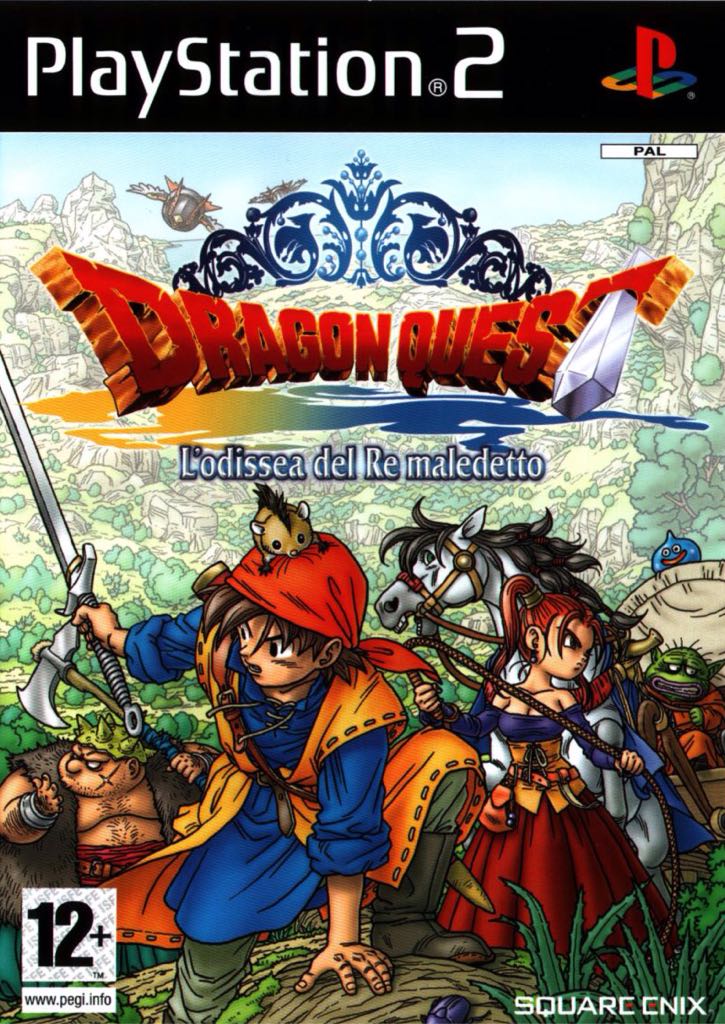
Dragon Quest - The Journey Of The Cursed King
Genre:
Role Playing Game
Show More
Release Date:
1969-12-31
Date Added:
2018-07-03 12:15:18
Game Summary:
Dragon Quest VIII: Journey of the Cursed King, known in Japan as Dragon Quest VIII Sora to Umi to Daichi to Norowareshi Himegimi (ドラゴンクエストVIII 空と海と大地と呪われし姫君, lit. "Dragon Quest VIII: The Sky, the Ocean, the Earth, and the Cursed Princess”) and in PAL regions as Dragon Quest: The Journey of the Cursed King, is a role-playing video game developed by Level-5 and published by Square Enix for the PlayStation 2. It was first released in Japan in 2004, and was later released in North America in 2005 and PAL regions in 2006, making it the first main series installment released in the PAL region.It is the eighth installment of the popular Dragon Quest series and it is the first English version of a Dragon Quest game to drop the Dragon Warrior title.
Dragon Quest VIII uses cel-shading textures for the characters and scenery and is the first game in the series to have fully 3D environments. The game retains most of the series’ role-playing game elements, such as turn-based combat and the experience level system. Dragon Quest VIII follows the silent Hero, the main character, and his party of allies as they journey towards the goal of defeating the wicked Dhoulmagus. The kingdom of Trodain has been cursed by Dhoulmagus, with the King, Trode, and his daughter, Medea, transformed into a troll and a horse respectively, and it is up to the Hero to return them to their original form and save the kingdom.
Dragon Quest VIII has enjoyed much success since its release, both in Japan and in the US. It is a Square Enix Ultimate Hits and a Sony Greatest Hits title. A survey conducted in 2006 by the magazine Famitsu earned the game the #4 spot as the best video game of all time after Final Fantasy X, Final Fantasy VII and Dragon Quest III.
Gameplay
Dragon Quest VIII retains the menu based battle system that is a staple for the series.
In Dragon Quest VIII, the player controls the Hero in a fully three-dimensional environment, utilizing the left analog stick or D-pad on the PlayStation controller to move him. Using the right analog stick, players can pan the camera a full 360 degrees around the character or in a first-person perspective. The visual controls allow players to examine people and objects more closely than the top-down perspective of the game’s predecessors. With a new fully integrated world, towns and dungeons are no longer identified by two-dimensional icons found on the world maps. Players can guide the Hero across vast landscapes to reach full-size towns and buildings.
Battles are randomly occurring and turn-based. When encountering an enemy, the game switches to a battle scene with the enemies facing the party where characters from both sides take turns attacking each other. These battle scenes have visually changed dramatically from earlier games in the series. In the earlier games, battles were shown from a first-person perspective. For this installment, the battles are shown in a first-person perspective while choosing what to do, but the view then shifts to a third-person perspective with all of the members of the Hero’s party shown on the screen along with the enemies. During battle, each character in the party has the ability to attack, use items, or use magic and skills. New to Dragon Quest VIII is the tension system, which allows the player to choose the "Psyche Up” command for a character during battle. This command allows the player to skip a character’s turn in order to build "tension”, making that character’s next attack stronger. By using it multiple times in succession, the character’s attack will do more damage. Another new feature, the Alchemy Pot allows players to mix items in order to create new, stronger items. This can be done while walking on the world map. There is also a monster capturing feature, but it is not as fundamental to the gameplay as it was in Dragon Quest V. The player may find enemies visible on the world map and can be recruited if defeated and used during the Monster Arena mini-game and during battle.
Through the traditional experience point system, characters advance through experience levels and develop their abilities, similar to previous games in the series. Defeating enemies grants experience points and gold to the party, which allows the player to purchase items and weapons at in-game shops. In addition to this, Level-5 incorporated a secondary skill development system to allow players a chance to customize each character to their liking. After characters gain an experience level past level four, they accrue skill points distributed as the player chooses among five different skills—three different weapons, "fisticuffs”, and a special attribute. Gaining enough points in a skill can allow the character to gain strength in weapons and learn new abilities and magic spells.
Reception
Released for the PlayStation 2 on November 27, 2004 in Japan, Dragon Quest VIII went on to ship over three million copies within its first week, making it the fastest selling Japanese PlayStation 2 title upon release. By September, 2008, total worldwide shipments of Dragon Quest VIII surpassed 4.9 million copies, of which over 430,000 were from the North American release. Dragon Quest VIII is the biggest selling game ever for the PlayStation 2 in Japan. It was the first Dragon Quest game to receive a score of 39 out of 40 from Famitsu. It won both 1UP.com’s and GameSpy’s "Best RPG of E3 2005” award, ahead of runner-up Kingdom Hearts II.
The US release of Dragon Quest VIII has received generally positive critical reviews, receiving a score of 89 out of 100 on Metacritic. Critics were quick to praise the 3D cel shaded visuals, noting that it was the first game in the series to be fully three-dimensional. A staple of the Dragon Quest series is the simplicity of its gameplay, a factor which has been criticized in the past. However, several critics pointed out that the simple gameplay works for Dragon Quest VIII. Simon Parkin of Eurogamer called the game "refreshing”, comparing it to the contemporaneous Final Fantasy series and games from developer Nippon Ichi Software, which he finds to be too complicated. Bethany Massimilla of GameSpot wrote that the lack of "dozens of characters of all types” allows the game to remain simple, letting the player become very familiar with the main characters. Edge magazine, however, commented that the game’s substance seemed out of place for 2005.
A majority of reviewers cited the English localization of the game as one of its best qualities. Nich Maragos of 1UP.com praised the game’s British tinted localization, saying how the humor is often successful except for "a few puns that will, on occasion, make you want to die”. Parkin described the voice acting as "a mash up of Monty Python and The Princess Bride: fantasy farce driving the cute narrative in the ideal aural vehicle”. The game’s world map has also been a major topic of praise for critics. The 1UP.com staff suggested that the player stop playing "to just look around and absorb the scenery” and said that it rivals Grand Theft Auto: San Andreas’ map of San Andreas in size and detail. IGN writer Jeremy Dunham wrote that the "only exception in the game’s mass list of progression is the plotline”, explaining that it has one of the more basic Dragon Quest stories; but he also mentions that the game still manages to take a dull plot and make it entertaining.
Legacy
Characters from the game have made appearances in other Square Enix properties. Dragon Quest Yangus, a roguelike Mysterious Dungeons game developed by Cavia for the PlayStation 2, follows the storyline of a young Yangus. It was released in Japan in 2006. Jessica, Angelo, and Yangus also appear opposite other Dragon Quest characters, as well as Final Fantasy and Mario characters in titles of the Itadaki Street franchise, a cross-over board game spanning multiple platforms. Appearences include Dragon Quest & Final Fantasy in Itadaki Street Portable for the PlayStation Portable (PSP), Itadaki Street DS for the Nintendo DS and Itadaki Street Wii/Fortune Street, an enhanced remake of Itadaki Street DS for the Nintendo Wii Dragon Quest VIII characters also make appearances in Dragon Quest IX: Sentinels of the Starry Skies: Jessica, Angelo, and King Trode appear as special WI FI guests in the Quester’s Rest inn in Stornway, Dhoulmagus and Rhapthorne appear as optional legacy bosses, and the player can acquire a "Trodain Royal Guard” costume to dress as VIII’s Hero.
Dragon Quest VIII uses cel-shading textures for the characters and scenery and is the first game in the series to have fully 3D environments. The game retains most of the series’ role-playing game elements, such as turn-based combat and the experience level system. Dragon Quest VIII follows the silent Hero, the main character, and his party of allies as they journey towards the goal of defeating the wicked Dhoulmagus. The kingdom of Trodain has been cursed by Dhoulmagus, with the King, Trode, and his daughter, Medea, transformed into a troll and a horse respectively, and it is up to the Hero to return them to their original form and save the kingdom.
Dragon Quest VIII has enjoyed much success since its release, both in Japan and in the US. It is a Square Enix Ultimate Hits and a Sony Greatest Hits title. A survey conducted in 2006 by the magazine Famitsu earned the game the #4 spot as the best video game of all time after Final Fantasy X, Final Fantasy VII and Dragon Quest III.
Gameplay
Dragon Quest VIII retains the menu based battle system that is a staple for the series.
In Dragon Quest VIII, the player controls the Hero in a fully three-dimensional environment, utilizing the left analog stick or D-pad on the PlayStation controller to move him. Using the right analog stick, players can pan the camera a full 360 degrees around the character or in a first-person perspective. The visual controls allow players to examine people and objects more closely than the top-down perspective of the game’s predecessors. With a new fully integrated world, towns and dungeons are no longer identified by two-dimensional icons found on the world maps. Players can guide the Hero across vast landscapes to reach full-size towns and buildings.
Battles are randomly occurring and turn-based. When encountering an enemy, the game switches to a battle scene with the enemies facing the party where characters from both sides take turns attacking each other. These battle scenes have visually changed dramatically from earlier games in the series. In the earlier games, battles were shown from a first-person perspective. For this installment, the battles are shown in a first-person perspective while choosing what to do, but the view then shifts to a third-person perspective with all of the members of the Hero’s party shown on the screen along with the enemies. During battle, each character in the party has the ability to attack, use items, or use magic and skills. New to Dragon Quest VIII is the tension system, which allows the player to choose the "Psyche Up” command for a character during battle. This command allows the player to skip a character’s turn in order to build "tension”, making that character’s next attack stronger. By using it multiple times in succession, the character’s attack will do more damage. Another new feature, the Alchemy Pot allows players to mix items in order to create new, stronger items. This can be done while walking on the world map. There is also a monster capturing feature, but it is not as fundamental to the gameplay as it was in Dragon Quest V. The player may find enemies visible on the world map and can be recruited if defeated and used during the Monster Arena mini-game and during battle.
Through the traditional experience point system, characters advance through experience levels and develop their abilities, similar to previous games in the series. Defeating enemies grants experience points and gold to the party, which allows the player to purchase items and weapons at in-game shops. In addition to this, Level-5 incorporated a secondary skill development system to allow players a chance to customize each character to their liking. After characters gain an experience level past level four, they accrue skill points distributed as the player chooses among five different skills—three different weapons, "fisticuffs”, and a special attribute. Gaining enough points in a skill can allow the character to gain strength in weapons and learn new abilities and magic spells.
Reception
Released for the PlayStation 2 on November 27, 2004 in Japan, Dragon Quest VIII went on to ship over three million copies within its first week, making it the fastest selling Japanese PlayStation 2 title upon release. By September, 2008, total worldwide shipments of Dragon Quest VIII surpassed 4.9 million copies, of which over 430,000 were from the North American release. Dragon Quest VIII is the biggest selling game ever for the PlayStation 2 in Japan. It was the first Dragon Quest game to receive a score of 39 out of 40 from Famitsu. It won both 1UP.com’s and GameSpy’s "Best RPG of E3 2005” award, ahead of runner-up Kingdom Hearts II.
The US release of Dragon Quest VIII has received generally positive critical reviews, receiving a score of 89 out of 100 on Metacritic. Critics were quick to praise the 3D cel shaded visuals, noting that it was the first game in the series to be fully three-dimensional. A staple of the Dragon Quest series is the simplicity of its gameplay, a factor which has been criticized in the past. However, several critics pointed out that the simple gameplay works for Dragon Quest VIII. Simon Parkin of Eurogamer called the game "refreshing”, comparing it to the contemporaneous Final Fantasy series and games from developer Nippon Ichi Software, which he finds to be too complicated. Bethany Massimilla of GameSpot wrote that the lack of "dozens of characters of all types” allows the game to remain simple, letting the player become very familiar with the main characters. Edge magazine, however, commented that the game’s substance seemed out of place for 2005.
A majority of reviewers cited the English localization of the game as one of its best qualities. Nich Maragos of 1UP.com praised the game’s British tinted localization, saying how the humor is often successful except for "a few puns that will, on occasion, make you want to die”. Parkin described the voice acting as "a mash up of Monty Python and The Princess Bride: fantasy farce driving the cute narrative in the ideal aural vehicle”. The game’s world map has also been a major topic of praise for critics. The 1UP.com staff suggested that the player stop playing "to just look around and absorb the scenery” and said that it rivals Grand Theft Auto: San Andreas’ map of San Andreas in size and detail. IGN writer Jeremy Dunham wrote that the "only exception in the game’s mass list of progression is the plotline”, explaining that it has one of the more basic Dragon Quest stories; but he also mentions that the game still manages to take a dull plot and make it entertaining.
Legacy
Characters from the game have made appearances in other Square Enix properties. Dragon Quest Yangus, a roguelike Mysterious Dungeons game developed by Cavia for the PlayStation 2, follows the storyline of a young Yangus. It was released in Japan in 2006. Jessica, Angelo, and Yangus also appear opposite other Dragon Quest characters, as well as Final Fantasy and Mario characters in titles of the Itadaki Street franchise, a cross-over board game spanning multiple platforms. Appearences include Dragon Quest & Final Fantasy in Itadaki Street Portable for the PlayStation Portable (PSP), Itadaki Street DS for the Nintendo DS and Itadaki Street Wii/Fortune Street, an enhanced remake of Itadaki Street DS for the Nintendo Wii Dragon Quest VIII characters also make appearances in Dragon Quest IX: Sentinels of the Starry Skies: Jessica, Angelo, and King Trode appear as special WI FI guests in the Quester’s Rest inn in Stornway, Dhoulmagus and Rhapthorne appear as optional legacy bosses, and the player can acquire a "Trodain Royal Guard” costume to dress as VIII’s Hero.
Platform:
Sony PlayStation 2 (PS2)
Developers:
Show More
Input Devices:
Show More
Date Added:
2018-07-03 12:15:18