Title:
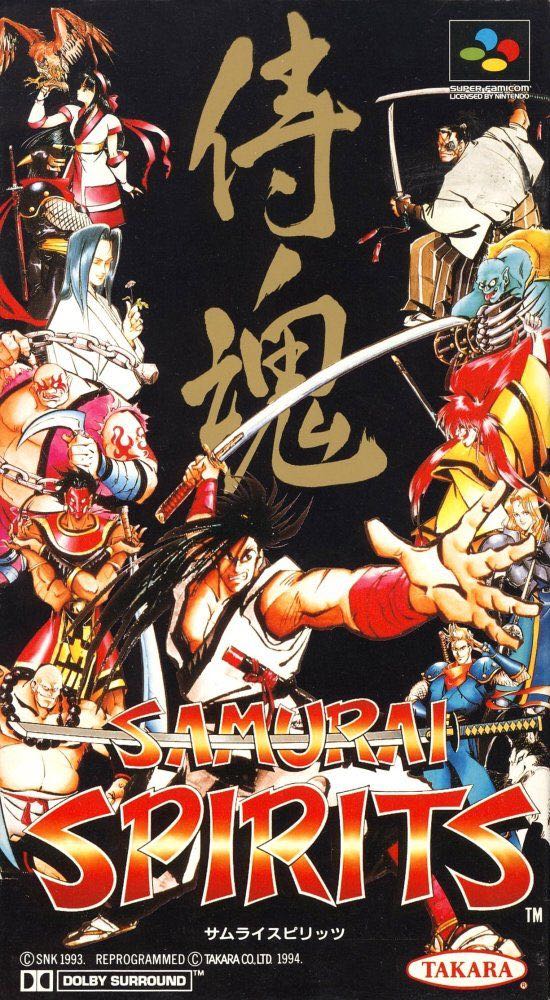
Samurai Spirits 侍魂 サムライスピリッツ (1993)
Genre:
Fighting
Show More
IGN Score:
8.5
Release Date:
1994-09-22
Date Added:
2018-07-03 12:31:39
Game Summary:
Samurai Shodown, known in Japan as Samurai Spirits, is a competitive fighting game developed and published by SNK for their Neo Geo arcade and home platform. Released in 1993, it is the first installment in the Samurai Shodown series. In contrast to other fighting games at the time, which were set in modern times and focused primarily on hand-to-hand combat, Samurai Shodown is set in feudal-era Japan (similar to Kaneko’s Shogun Warriors which was released the year prior) and was SNK’s first arcade fighting game to focus primarily on weapon-based combat.
Samurai Shodown was a commercial success, becoming Japan’s sixth highest-grossing arcade game of 1993 and one of America’s top five highest-grossing arcade conversion kits of 1994. It was also critically acclaimed, winning several Game of the Year awards from Gamest, Electronic Gaming Monthly and the European Computer Trade Show.
Gameplay:
The game is set in the late 18th century, and all the characters wield weapons. The game uses music from the time period, with sounds of traditional Japanese instruments, such as the shakuhachi and shamisen. A refined version of the camera zoom first found in Art of Fighting is used in Samurai Shodown. The game includes the portrayal of blood.
The game became renowned for its fast pace. Focusing more on quick, powerful strikes than combos, the slow motion was added to intensify the damage dealt from hard hits. During a match, a referee holds flags representing each player (Player 1 is white; Player 2 is red). When a player lands a successful hit, the referee lifts the corresponding flag, indicating who dealt the blow.
A delivery man occasionally appears in the background and throws items such as bombs or health-restoring chicken, which can change the outcome.
Plot:
Shiro Tokisada Amakusa, slain in Japan of 1638 by the forces of the Tokugawa Shogunate for his part in the Shimabara Rebellion, was resurrected in 1787 as an akuma from making a deal with the dark god Ambrosia by bringing the evil entity into the world by using the Palenke stone and its energy. Driven by hatred for the Shogunate and having a nihilistic streak towards the world, he unleashes his dark powers to bring chaos to all of existence in 1788. A variety of warriors — some historic, some fictional — converge upon the source of the chaos, each driven by their own reasons.
Release:
The Neo Geo AES version of the game was released for the Wii Virtual Console on October 16, 2007, in Japan; May 30, 2008, in Europe; and June 16, 2008, in North America. However, before the Virtual Console version was released in North America, the game was released as part of SNK Arcade Classics Vol. 1.
Mostly due to the negative publicity surrounding the use of violence in video games, the game was edited when it was first released for the AES as it featured blood and graphic fatal attacks that kill opponents by slicing them in half. As a result, it was decided to censor the game for most platforms by changing the blood from red to white and disabling the fatal attack animations. The win quotes were also censored, and references to death or blood were altered.
In the Super NES version, the blood was recolored orange and the fatal attacks were removed.
The 3DO version was first released in 1994 in North America, then in Japan and Europe the following year, with all blood and fatality graphics intact. As a result, some retailers didn’t carry this edition of the game.
The censoring of the Neo Geo console version was unusual in that it was tied to the specific system. For instance, a North American cartridge running on a North American Neo Geo would display white sweat, but the same cartridge, when plugged into a Japanese Neo Geo, would run the uncensored game with blood. Neo Geo console modifications would enable users to set the system’s region to Japan, or play in arcade mode, either of which would cause the game to be played with all of the blood and death animations intact, even on a North American/PAL console.
• Version differences
In addition to the Neo Geo system, the AES, Samurai Shodown was ported to multiple other platforms, including the Super NES, Game Boy, Mega Drive/Genesis, Game Gear, Sega CD, Sega Saturn, 3DO, FM Towns, PlayStation and PlayStation 2. All of the cartridge versions were handled by Takara, while Crystal Dynamics ported the 3DO version, and Funcom handled the Sega CD port.
The Mega Drive/Genesis and Sega CD versions omit the character Earthquake and his stage. Both versions lack the camera zoom, and the camera is locked in a close zoom. This gives better detail to the characters, but the fighting area is smaller. In addition, some attacks were altered or removed entirely from the Mega Drive/Genesis version of the game. The final boss is playable in the two-player mode without the use of a code. The Mega Drive/Genesis version lacks the arcade introduction, instead of displaying the arcade version’s text with no background graphics or speech. Also, the character artwork shown after beating an opponent is missing, and portions of some characters’ endings are missing. The announcer no longer says the names of the characters before a fight or after winning a fight. The Sega CD version retains the arcade introduction and is only missing portions of some characters’ endings. The Sega CD version also includes the attacks that were removed or altered in the Mega Drive/Genesis version, and the music is the same as the arcade version.
The SNES version has the character line-up intact but has the game zoomed out, which makes the character sprites smaller compared to the other ports. This version has all of the stages from the arcade version, and they are less restricted compared to the Mega Drive/Genesis and Sega CD ports. This version also supports Dolby Surround sound. The SNES version includes the arcade intro sequence, although the voice accompanying the text is missing, the character artwork shown after beating an opponent is present, as are the arcade endings. The announcer, like the Sega CD version, says the names of the characters before a fight and after winning a fight. The SNES version has no blood, being replaced by sweat. An exclusive mode, count down, is included in this port. Players can also use the final boss in two-player mode with a secret code.
The Game Boy version includes all the characters, stages, and most of the special moves, but has no combos, fatalities, or voices. All the music tracks are included, albeit in scaled-down form.
The Game Gear port offered only 9 fighting characters to choose from (Gen-An, Galford, Haohmaru, Ukyo, Charlotte, Nakoruru, Jubei, Hanzo, and Kyoshiro), whilst the original (SNK arcades) version offered 12.
Unlike most early home versions of the game, the 3DO version includes the camera zoom, as well as all the characters, special moves, and fatalities.
Anime:
Three anime adaptations based on the game have been made. Samurai Spirits: Haten Gouma no Shou in 1994, which is a full-length film; Samurai Spirits 2: Asura Zanmaden in 1999, with two episodes and Nakoruru ~Ano hito kara no okurimono~ in 2002, a one-episode OVA.
Description:
Lost in a forgotten era... You are a fierce Samurai warrior with only one goal. To seek out and defeat your enemies with all your strength and skills. Armed only with your sword, you must rely on your keen instincts while you do battle with some of the strongest and craftiest Knights, Ninjas, and tough guys ever assembled.
Samurai Shodown was a commercial success, becoming Japan’s sixth highest-grossing arcade game of 1993 and one of America’s top five highest-grossing arcade conversion kits of 1994. It was also critically acclaimed, winning several Game of the Year awards from Gamest, Electronic Gaming Monthly and the European Computer Trade Show.
Gameplay:
The game is set in the late 18th century, and all the characters wield weapons. The game uses music from the time period, with sounds of traditional Japanese instruments, such as the shakuhachi and shamisen. A refined version of the camera zoom first found in Art of Fighting is used in Samurai Shodown. The game includes the portrayal of blood.
The game became renowned for its fast pace. Focusing more on quick, powerful strikes than combos, the slow motion was added to intensify the damage dealt from hard hits. During a match, a referee holds flags representing each player (Player 1 is white; Player 2 is red). When a player lands a successful hit, the referee lifts the corresponding flag, indicating who dealt the blow.
A delivery man occasionally appears in the background and throws items such as bombs or health-restoring chicken, which can change the outcome.
Plot:
Shiro Tokisada Amakusa, slain in Japan of 1638 by the forces of the Tokugawa Shogunate for his part in the Shimabara Rebellion, was resurrected in 1787 as an akuma from making a deal with the dark god Ambrosia by bringing the evil entity into the world by using the Palenke stone and its energy. Driven by hatred for the Shogunate and having a nihilistic streak towards the world, he unleashes his dark powers to bring chaos to all of existence in 1788. A variety of warriors — some historic, some fictional — converge upon the source of the chaos, each driven by their own reasons.
Release:
The Neo Geo AES version of the game was released for the Wii Virtual Console on October 16, 2007, in Japan; May 30, 2008, in Europe; and June 16, 2008, in North America. However, before the Virtual Console version was released in North America, the game was released as part of SNK Arcade Classics Vol. 1.
Mostly due to the negative publicity surrounding the use of violence in video games, the game was edited when it was first released for the AES as it featured blood and graphic fatal attacks that kill opponents by slicing them in half. As a result, it was decided to censor the game for most platforms by changing the blood from red to white and disabling the fatal attack animations. The win quotes were also censored, and references to death or blood were altered.
In the Super NES version, the blood was recolored orange and the fatal attacks were removed.
The 3DO version was first released in 1994 in North America, then in Japan and Europe the following year, with all blood and fatality graphics intact. As a result, some retailers didn’t carry this edition of the game.
The censoring of the Neo Geo console version was unusual in that it was tied to the specific system. For instance, a North American cartridge running on a North American Neo Geo would display white sweat, but the same cartridge, when plugged into a Japanese Neo Geo, would run the uncensored game with blood. Neo Geo console modifications would enable users to set the system’s region to Japan, or play in arcade mode, either of which would cause the game to be played with all of the blood and death animations intact, even on a North American/PAL console.
• Version differences
In addition to the Neo Geo system, the AES, Samurai Shodown was ported to multiple other platforms, including the Super NES, Game Boy, Mega Drive/Genesis, Game Gear, Sega CD, Sega Saturn, 3DO, FM Towns, PlayStation and PlayStation 2. All of the cartridge versions were handled by Takara, while Crystal Dynamics ported the 3DO version, and Funcom handled the Sega CD port.
The Mega Drive/Genesis and Sega CD versions omit the character Earthquake and his stage. Both versions lack the camera zoom, and the camera is locked in a close zoom. This gives better detail to the characters, but the fighting area is smaller. In addition, some attacks were altered or removed entirely from the Mega Drive/Genesis version of the game. The final boss is playable in the two-player mode without the use of a code. The Mega Drive/Genesis version lacks the arcade introduction, instead of displaying the arcade version’s text with no background graphics or speech. Also, the character artwork shown after beating an opponent is missing, and portions of some characters’ endings are missing. The announcer no longer says the names of the characters before a fight or after winning a fight. The Sega CD version retains the arcade introduction and is only missing portions of some characters’ endings. The Sega CD version also includes the attacks that were removed or altered in the Mega Drive/Genesis version, and the music is the same as the arcade version.
The SNES version has the character line-up intact but has the game zoomed out, which makes the character sprites smaller compared to the other ports. This version has all of the stages from the arcade version, and they are less restricted compared to the Mega Drive/Genesis and Sega CD ports. This version also supports Dolby Surround sound. The SNES version includes the arcade intro sequence, although the voice accompanying the text is missing, the character artwork shown after beating an opponent is present, as are the arcade endings. The announcer, like the Sega CD version, says the names of the characters before a fight and after winning a fight. The SNES version has no blood, being replaced by sweat. An exclusive mode, count down, is included in this port. Players can also use the final boss in two-player mode with a secret code.
The Game Boy version includes all the characters, stages, and most of the special moves, but has no combos, fatalities, or voices. All the music tracks are included, albeit in scaled-down form.
The Game Gear port offered only 9 fighting characters to choose from (Gen-An, Galford, Haohmaru, Ukyo, Charlotte, Nakoruru, Jubei, Hanzo, and Kyoshiro), whilst the original (SNK arcades) version offered 12.
Unlike most early home versions of the game, the 3DO version includes the camera zoom, as well as all the characters, special moves, and fatalities.
Anime:
Three anime adaptations based on the game have been made. Samurai Spirits: Haten Gouma no Shou in 1994, which is a full-length film; Samurai Spirits 2: Asura Zanmaden in 1999, with two episodes and Nakoruru ~Ano hito kara no okurimono~ in 2002, a one-episode OVA.
Description:
Lost in a forgotten era... You are a fierce Samurai warrior with only one goal. To seek out and defeat your enemies with all your strength and skills. Armed only with your sword, you must rely on your keen instincts while you do battle with some of the strongest and craftiest Knights, Ninjas, and tough guys ever assembled.
Platform:
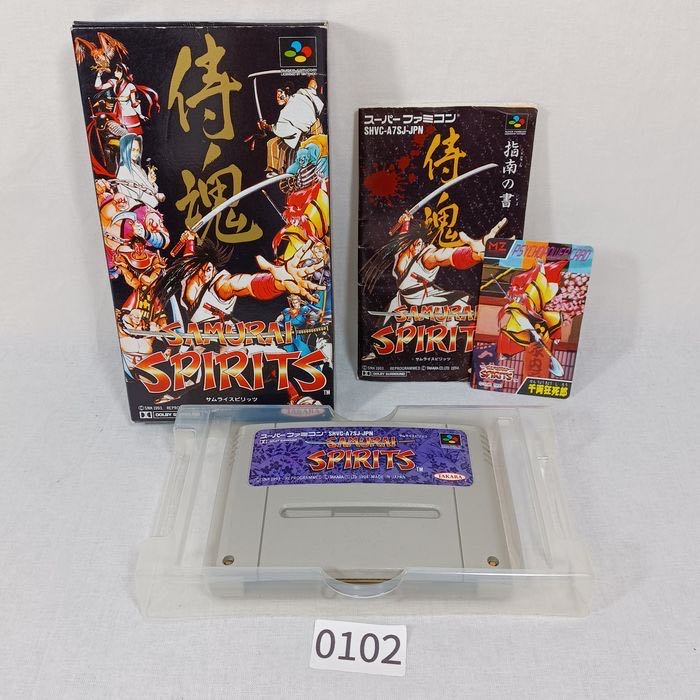
Nintendo Super Famicom
Publisher:
SNK
Developers:
Takara / SNK
Show More
Players:
1-2
Country of Purchase:
United States
Graphics:
16-bit
Input Devices:
Controller Game Pad
Show More
Media Type:
Cartridge
Game Modes:
Single Player
Multiplayer
Competitive
Show More
Packaging:
Cardboard Box
Date Added:
2018-07-03 12:31:39