Title:
Ultimate Mortal Kombat 3
Series:
Mortal Kombat
Series Order:
3
Rating:
M
Genre:
Fighting
Arcade
Show More
IGN Score:
8.6
Release Date:
1996-10-11
Date Added:
2018-07-03 12:35:06
Game Summary:
Ultimate Mortal Kombat 3 is a 1995 fighting game developed and published by Midway for arcades. Part of the Mortal Kombat series, it is a standalone update of 1995’s earlier Mortal Kombat 3 with an altered gameplay system, additional characters like the returning favorites Reptile, Kitana, Jade and Scorpion who were missing from Mortal Kombat 3, and some new features.
Several home port versions of the game were soon released after the arcade original. Although none were completely identical to the arcade version, the Sega Saturn port came closest. Some later home versions followed the arcade original with more accuracy. Some versions were released under different titles: Mortal Kombat Advance for the Game Boy Advance in 2001 and Ultimate Mortal Kombat for the Nintendo DS in 2007. An iOS version recreating the game using a 3D graphics engine was released by Electronic Arts in 2010.
Ultimate Mortal Kombat 3 was mostly well-received and has been considered a high point for the Mortal Kombat series. However, the iOS remake and some other home versions were received poorly. Ultimate Mortal Kombat 3 was updated to include more content from previous games in the series as Mortal Kombat Trilogy in 1996. The 2011 compilation Mortal Kombat Arcade Kollection includes an emulation of UMK3 as well as the first Mortal Kombat and Mortal Kombat II.
Description:
Prepare for the fight of your life! Enter the world of ULTIMATE Mortal Kombat 3 and discover 22 playable characters, classic fatalities, brutalities, friendships, and babalities with tons of environments, and multiplayer Kombat Mode as you fight to defeat Shao Kahn!
FINISH HIM!!!
Characters:
The arcade version features all playable characters from Mortal Kombat 3, who were portrayed by the same actors: Cyrax (Sal Divita), Liu Kang (Eddie Wong), Kabal (Richard Divizio), Kano (Richard Divizio), Kung Lao (Tony Marquez), Stryker (Michael O’Brien), Jax Briggs (John Parrish), Nightwolf (Sal Divita), Sektor (Sal Divita), Shang Tsung (John Turk), Sheeva (stop motion), Sindel (Lia Montelongo), Smoke (Sal Divita), Sonya Blade (Kerri Hoskins) and Sub-Zero (John Turk). The boss and sub-boss from MK3, Motaro (stop motion) and Shao Kahn (Brian Glynn, voiced by Steve Ritchie), also return. Shang Tsung’s transformations are accompanied by announcements of the name of the character he is changing into.
There are four additional characters that are playable from the start: several ninja characters from the first two games that have been absent from Mortal Kombat 3 return in Ultimate Mortal Kombat 3, including Kitana, Jade, Reptile and Scorpion on the prototype version; a new Ultimate Kombat Kode was added in revision 1.0 to enable Mileena, Ermac, and Classic Sub-Zero as secret characters.
• Jade (Becky Gable) – After the renegade princess Kitana killed her evil twin Mileena and escaped from Outworld to Earth, her close friend Jade was appointed by the emperor Shao Kahn to find and bring her back alive.
• Kitana (Becky Gable) – She is accused of treason after killing Mileena; she now attempts to reach queen Sindel to warn her of their true past.
• Reptile (John Turk) – As one of Shao Kahn’s most trusted servants, Reptile assists Jade in the hunt for Kitana, but with secret orders enabling him to kill her if necessary.
• Scorpion (John Turk) – Scorpion escapes from Earth’s hell after Shao Kahn’s failed attempt at stealing the souls of Earthrealm. He eventually joins the struggle against Outworld.
More are unlockable via the Ultimate Kombat Kode:
• Classic Sub-Zero (John Turk) – Having been seemingly killed in the first game, Sub-Zero mysteriously returns to again attempt the assassination of Shang Tsung.
• Ermac (John Turk) – A mysterious warrior that exists as a life force of the souls of dead Outworld warriors in Shao Kahn’s possession.
• Mileena (Becky Gable) – After she was killed by Kitana, Mileena was brought back to life by Shao Kahn to help him defeat Earth’s warriors with her combat skills and a mind-reading connection to her sister.
Finally, Smoke’s human form can be unlocked via a code entered right before a match.
Returning characters were warmly welcomed by critics as an improvement to the ”lackluster roster” of MK3 with ”the greatly missed” Kitana, Mileena, Reptile, and especially Scorpion. The female ninja characters (Mileena, Kitana and Jade), returning from Mortal Kombat II, were portrayed by a different actress, Becky Gable, due to the lawsuit issued by Katalin Zamiar and some of the other MKII actors against Midway; they were also given a different set of outfits and hairstyles, which were again identical for all of them (in the game there are just three palette swapped character models for male, female and cyborg ninjas, not counting the MK3 Sub-Zero but including Classic Sub-Zero).
There are also two new hidden opponents and console exclusives: Noob Saibot (John Turk) and Rain (John Turk). Although Noob Saibot was featured in the original MK3, he is no longer a palette swap of Kano but instead of a ninja; as before, he is fought via a Kombat Kode. Rain is featured in the game’s opening montage (except on the Sega Saturn), but he is actually a fake hidden character that is not found in the arcade game. Both Noob Saibot and Rain were made playable for the 16-bit console versions, although Sheeva was removed, and the two boss characters are playable via a cheat code.
Release:
• Super NES
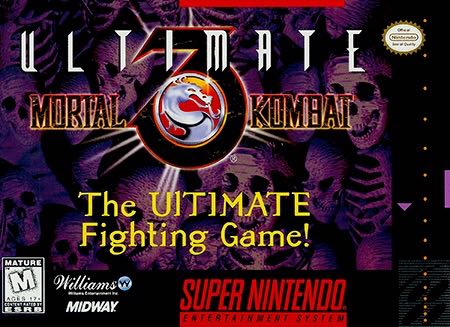
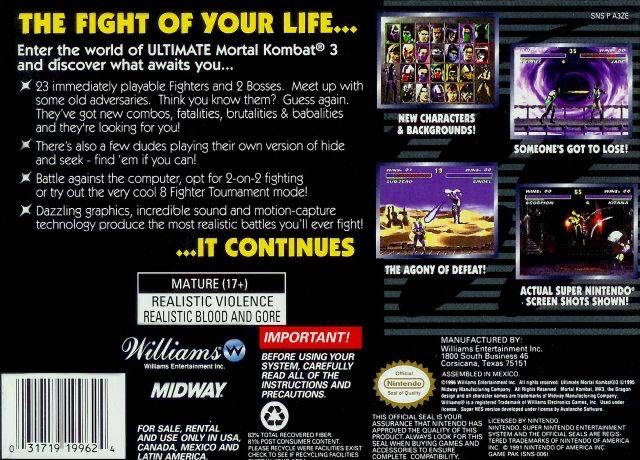
The Super Nintendo Entertainment System (SNES) version was developed by Avalanche Software and published by Williams Entertainment in June, 1996 in North America, and by Acclaim Entertainment on November 28, 1996, in Europe. This version of the game uses the code from Sculptured Software’s prior port of the original MK3 released a year earlier. The limitations of the system led to many cuts being made to fit everything in the SNES cartridge: the announcer no longer says the characters’ names, Sheeva was removed,[notes 2] only the five new arcade backgrounds are featured, and Shao Kahn’s Lost Treasures chest has only 10 boxes instead of 12. Also, many changes affect the game’s finishing moves: Rain and Noob Saibot have no regular Fatalities or other finishing moves; Kitana’s ”Kiss of Death” only inflates the opponent’s heads, reusing the effect from Kabal’s ”Air Pump” Fatality; Sonya Blade’s Friendship from MK3 is used, as opposed to her Friendship from the arcade version of UMK3; Ermac’s head punch Fatality is altered; Scorpion’s ”Hellraiser” Fatality is different (he takes the opponent back to the Hell stage, where the opponent simply burns to ash) and is no longer censored like the arcade one. Animality finishing moves were also removed, while still keeping the Mercy move, which originally served as a requirement for Animalities in MK3. On the other hand, Brutalities were introduced; a finishing move in which the player attacks their opponent with a series of kicks and punches which result in the victim exploding. At the same time, some changes were actually improvements over the arcade version. Rain and Noob Saibot are made into playable characters for the first time. Mileena, Ermac, and Classic Sub-Zero are playable out of the box. Motaro and Shao Kahn are unlockable characters for two-player fights, although only one player can choose a boss at a given time. A cheat code allows access to three separate cheat menus, where the player can drastically alter gameplay, access hidden content or view the characters’ endings, among many other things.
• Sega Genesis
The Sega Genesis version was developed by Avalanche Software and published by Williams Entertainment on October 11, 1996, in North America and by Acclaim Entertainment on November 28, 1996, in Europe (Mega Drive version). Much like the SNES port, this version of the game uses the code from Sculptured Software’s prior port of the original MK3 released a year earlier. Due to the limitations of the system’s hardware, the Sega Genesis port featured inferior graphics and sound to that of the SNES port. Like on the SNES, Sheeva was removed, Shao Kahn’s treasure chest has only 10 boxes, the announcer no longer says the characters’ names, Kitana’s ”Kiss of Death” only inflates heads, Scorpion’s ”Hellraiser” Fatality is different, Sonya’s Friendship from Mortal Kombat 3 is used, and the game retains the Bank stage. There were, however, several differences. Unlike the SNES version, the Genesis version features more stages: with the addition of the five new ones, it also features six of the original ones from MK3, including the Subway, Bank, Rooftop, Soul Chamber, The Temple, and The Pit 3. There are several additional cuts regarding special and finishing moves: both Animalities and Mercy were removed; Rain and Noob were given a Brutality, but no other finishing moves; Human Smoke shares Scorpion’s combos, rather than having unique ones; in Stryker’s Friendship, the running characters are replaced by dogs. It did, however, have exclusive features in comparison to the arcade. Again, like the SNES port, Rain and Noob Saibot are made playable characters along with bosses Motaro and Shao Kahn, and Mileena, Ermac, and Classic Sub-Zero are playable without any need of codes; Brutalities are also included in this version. Shang Tsung can morph into Robot Smoke, Noob Saibot, and Rain, which is not possible in the arcades, while Nightwolf is given the Red Shadow shoulder move that was later used in MKT. This version also features a rendition of Pong entitled MK4, which is the same as the one that appeared in the Genesis/Mega Drive port of MK3.
Several home port versions of the game were soon released after the arcade original. Although none were completely identical to the arcade version, the Sega Saturn port came closest. Some later home versions followed the arcade original with more accuracy. Some versions were released under different titles: Mortal Kombat Advance for the Game Boy Advance in 2001 and Ultimate Mortal Kombat for the Nintendo DS in 2007. An iOS version recreating the game using a 3D graphics engine was released by Electronic Arts in 2010.
Ultimate Mortal Kombat 3 was mostly well-received and has been considered a high point for the Mortal Kombat series. However, the iOS remake and some other home versions were received poorly. Ultimate Mortal Kombat 3 was updated to include more content from previous games in the series as Mortal Kombat Trilogy in 1996. The 2011 compilation Mortal Kombat Arcade Kollection includes an emulation of UMK3 as well as the first Mortal Kombat and Mortal Kombat II.
Description:
Prepare for the fight of your life! Enter the world of ULTIMATE Mortal Kombat 3 and discover 22 playable characters, classic fatalities, brutalities, friendships, and babalities with tons of environments, and multiplayer Kombat Mode as you fight to defeat Shao Kahn!
FINISH HIM!!!
Characters:
The arcade version features all playable characters from Mortal Kombat 3, who were portrayed by the same actors: Cyrax (Sal Divita), Liu Kang (Eddie Wong), Kabal (Richard Divizio), Kano (Richard Divizio), Kung Lao (Tony Marquez), Stryker (Michael O’Brien), Jax Briggs (John Parrish), Nightwolf (Sal Divita), Sektor (Sal Divita), Shang Tsung (John Turk), Sheeva (stop motion), Sindel (Lia Montelongo), Smoke (Sal Divita), Sonya Blade (Kerri Hoskins) and Sub-Zero (John Turk). The boss and sub-boss from MK3, Motaro (stop motion) and Shao Kahn (Brian Glynn, voiced by Steve Ritchie), also return. Shang Tsung’s transformations are accompanied by announcements of the name of the character he is changing into.
There are four additional characters that are playable from the start: several ninja characters from the first two games that have been absent from Mortal Kombat 3 return in Ultimate Mortal Kombat 3, including Kitana, Jade, Reptile and Scorpion on the prototype version; a new Ultimate Kombat Kode was added in revision 1.0 to enable Mileena, Ermac, and Classic Sub-Zero as secret characters.
• Jade (Becky Gable) – After the renegade princess Kitana killed her evil twin Mileena and escaped from Outworld to Earth, her close friend Jade was appointed by the emperor Shao Kahn to find and bring her back alive.
• Kitana (Becky Gable) – She is accused of treason after killing Mileena; she now attempts to reach queen Sindel to warn her of their true past.
• Reptile (John Turk) – As one of Shao Kahn’s most trusted servants, Reptile assists Jade in the hunt for Kitana, but with secret orders enabling him to kill her if necessary.
• Scorpion (John Turk) – Scorpion escapes from Earth’s hell after Shao Kahn’s failed attempt at stealing the souls of Earthrealm. He eventually joins the struggle against Outworld.
More are unlockable via the Ultimate Kombat Kode:
• Classic Sub-Zero (John Turk) – Having been seemingly killed in the first game, Sub-Zero mysteriously returns to again attempt the assassination of Shang Tsung.
• Ermac (John Turk) – A mysterious warrior that exists as a life force of the souls of dead Outworld warriors in Shao Kahn’s possession.
• Mileena (Becky Gable) – After she was killed by Kitana, Mileena was brought back to life by Shao Kahn to help him defeat Earth’s warriors with her combat skills and a mind-reading connection to her sister.
Finally, Smoke’s human form can be unlocked via a code entered right before a match.
Returning characters were warmly welcomed by critics as an improvement to the ”lackluster roster” of MK3 with ”the greatly missed” Kitana, Mileena, Reptile, and especially Scorpion. The female ninja characters (Mileena, Kitana and Jade), returning from Mortal Kombat II, were portrayed by a different actress, Becky Gable, due to the lawsuit issued by Katalin Zamiar and some of the other MKII actors against Midway; they were also given a different set of outfits and hairstyles, which were again identical for all of them (in the game there are just three palette swapped character models for male, female and cyborg ninjas, not counting the MK3 Sub-Zero but including Classic Sub-Zero).
There are also two new hidden opponents and console exclusives: Noob Saibot (John Turk) and Rain (John Turk). Although Noob Saibot was featured in the original MK3, he is no longer a palette swap of Kano but instead of a ninja; as before, he is fought via a Kombat Kode. Rain is featured in the game’s opening montage (except on the Sega Saturn), but he is actually a fake hidden character that is not found in the arcade game. Both Noob Saibot and Rain were made playable for the 16-bit console versions, although Sheeva was removed, and the two boss characters are playable via a cheat code.
Release:
• Super NES
The Super Nintendo Entertainment System (SNES) version was developed by Avalanche Software and published by Williams Entertainment in June, 1996 in North America, and by Acclaim Entertainment on November 28, 1996, in Europe. This version of the game uses the code from Sculptured Software’s prior port of the original MK3 released a year earlier. The limitations of the system led to many cuts being made to fit everything in the SNES cartridge: the announcer no longer says the characters’ names, Sheeva was removed,[notes 2] only the five new arcade backgrounds are featured, and Shao Kahn’s Lost Treasures chest has only 10 boxes instead of 12. Also, many changes affect the game’s finishing moves: Rain and Noob Saibot have no regular Fatalities or other finishing moves; Kitana’s ”Kiss of Death” only inflates the opponent’s heads, reusing the effect from Kabal’s ”Air Pump” Fatality; Sonya Blade’s Friendship from MK3 is used, as opposed to her Friendship from the arcade version of UMK3; Ermac’s head punch Fatality is altered; Scorpion’s ”Hellraiser” Fatality is different (he takes the opponent back to the Hell stage, where the opponent simply burns to ash) and is no longer censored like the arcade one. Animality finishing moves were also removed, while still keeping the Mercy move, which originally served as a requirement for Animalities in MK3. On the other hand, Brutalities were introduced; a finishing move in which the player attacks their opponent with a series of kicks and punches which result in the victim exploding. At the same time, some changes were actually improvements over the arcade version. Rain and Noob Saibot are made into playable characters for the first time. Mileena, Ermac, and Classic Sub-Zero are playable out of the box. Motaro and Shao Kahn are unlockable characters for two-player fights, although only one player can choose a boss at a given time. A cheat code allows access to three separate cheat menus, where the player can drastically alter gameplay, access hidden content or view the characters’ endings, among many other things.
• Sega Genesis
The Sega Genesis version was developed by Avalanche Software and published by Williams Entertainment on October 11, 1996, in North America and by Acclaim Entertainment on November 28, 1996, in Europe (Mega Drive version). Much like the SNES port, this version of the game uses the code from Sculptured Software’s prior port of the original MK3 released a year earlier. Due to the limitations of the system’s hardware, the Sega Genesis port featured inferior graphics and sound to that of the SNES port. Like on the SNES, Sheeva was removed, Shao Kahn’s treasure chest has only 10 boxes, the announcer no longer says the characters’ names, Kitana’s ”Kiss of Death” only inflates heads, Scorpion’s ”Hellraiser” Fatality is different, Sonya’s Friendship from Mortal Kombat 3 is used, and the game retains the Bank stage. There were, however, several differences. Unlike the SNES version, the Genesis version features more stages: with the addition of the five new ones, it also features six of the original ones from MK3, including the Subway, Bank, Rooftop, Soul Chamber, The Temple, and The Pit 3. There are several additional cuts regarding special and finishing moves: both Animalities and Mercy were removed; Rain and Noob were given a Brutality, but no other finishing moves; Human Smoke shares Scorpion’s combos, rather than having unique ones; in Stryker’s Friendship, the running characters are replaced by dogs. It did, however, have exclusive features in comparison to the arcade. Again, like the SNES port, Rain and Noob Saibot are made playable characters along with bosses Motaro and Shao Kahn, and Mileena, Ermac, and Classic Sub-Zero are playable without any need of codes; Brutalities are also included in this version. Shang Tsung can morph into Robot Smoke, Noob Saibot, and Rain, which is not possible in the arcades, while Nightwolf is given the Red Shadow shoulder move that was later used in MKT. This version also features a rendition of Pong entitled MK4, which is the same as the one that appeared in the Genesis/Mega Drive port of MK3.
Platform:
Nintendo Super Nintendo Entertainment System (SNES)
Publisher:
Midway Games / Williams Entertainment
Developers:
Midway Games / Avalanche Software
Show More
Players:
1-2
Country of Purchase:
United States
Graphics:
16-bit
Input Devices:
Controller Game Pad
Show More
Media Type:
Cartridge
Game Modes:
Single Player
Multiplayer
Competitive
Show More
Packaging:
Cardboard Box
Automatic Estimated Value:
~$72.79
Automatic Estimated Date:
2025-12-07
Date Added:
2018-07-03 12:35:06