
Trading cards are having a moment. Actually, they have been having a moment since about 2020, and it shows no signs of stopping. Pokemon, Magic: The Gathering, Yu-Gi-Oh!, baseball, football, basketball, and soccer cards are all seeing record prices and growing collector bases.
If you are just getting into cards, or thinking about starting, this guide covers the basics without the jargon overload.
Pick Your Lane
The trading card world splits into two broad categories:
TCG (Trading Card Games): Pokemon, Magic: The Gathering, Yu-Gi-Oh!, One Piece, Lorcana. These are cards designed to be played as a game. They also happen to be collectible, and some are worth a lot of money. The collectible value is driven by rarity, playability (cards used in competitive decks are worth more), and artwork.
Sports Cards: Baseball, football, basketball, hockey, soccer. These are collectible cards of real athletes. Value is driven by the player’s career (rookie cards of superstars are worth the most), card condition, and whether the card is autographed or has a game-used jersey patch (“relic” cards).
You don’t have to pick one or the other. But most collectors naturally gravitate toward either TCG or sports. Figure out which one excites you and start there.
How to Start (Without Spending a Fortune)
Set a Budget
This is the most important step and almost nobody does it. Cards are designed to make you open “just one more pack.” Set a monthly budget and stick to it. $50/month gets you a solid start. $20/month works if you are patient.
Buy Singles, Not Packs (Mostly)
This is the advice every experienced collector gives and every new collector ignores. If you want a specific card, buy that specific card from a marketplace (TCGplayer for game cards, eBay for sports cards). Buying packs to chase one specific card is almost always more expensive than just buying the card directly.
That said, opening packs is fun. Budget some “fun money” for pack opening and some “smart money” for buying the singles you actually want.
Start with One Set
Don’t try to collect everything. Pick one set from a game or sport you care about and try to complete it. A complete set of a modern Pokemon expansion is 200-300 cards and costs $50-$200 to complete by buying singles. That gives you a focused goal instead of a random pile of cards.
Protecting Your Cards
Cards lose value fast if they get damaged. From day one:
- Penny sleeves for every card worth more than $1 (cost: about $0.01 per sleeve)
- Top loaders for cards worth more than $10 (cost: about $0.10-$0.25 each)
- Card binders with side-loading pages for organizing sets (cost: $10-$20 for a binder)
- Keep cards out of direct sunlight. UV fades ink and warps cards.
- Control humidity. Cardboard absorbs moisture. Store in a dry room, not a basement or garage.
Tracking Your Collection
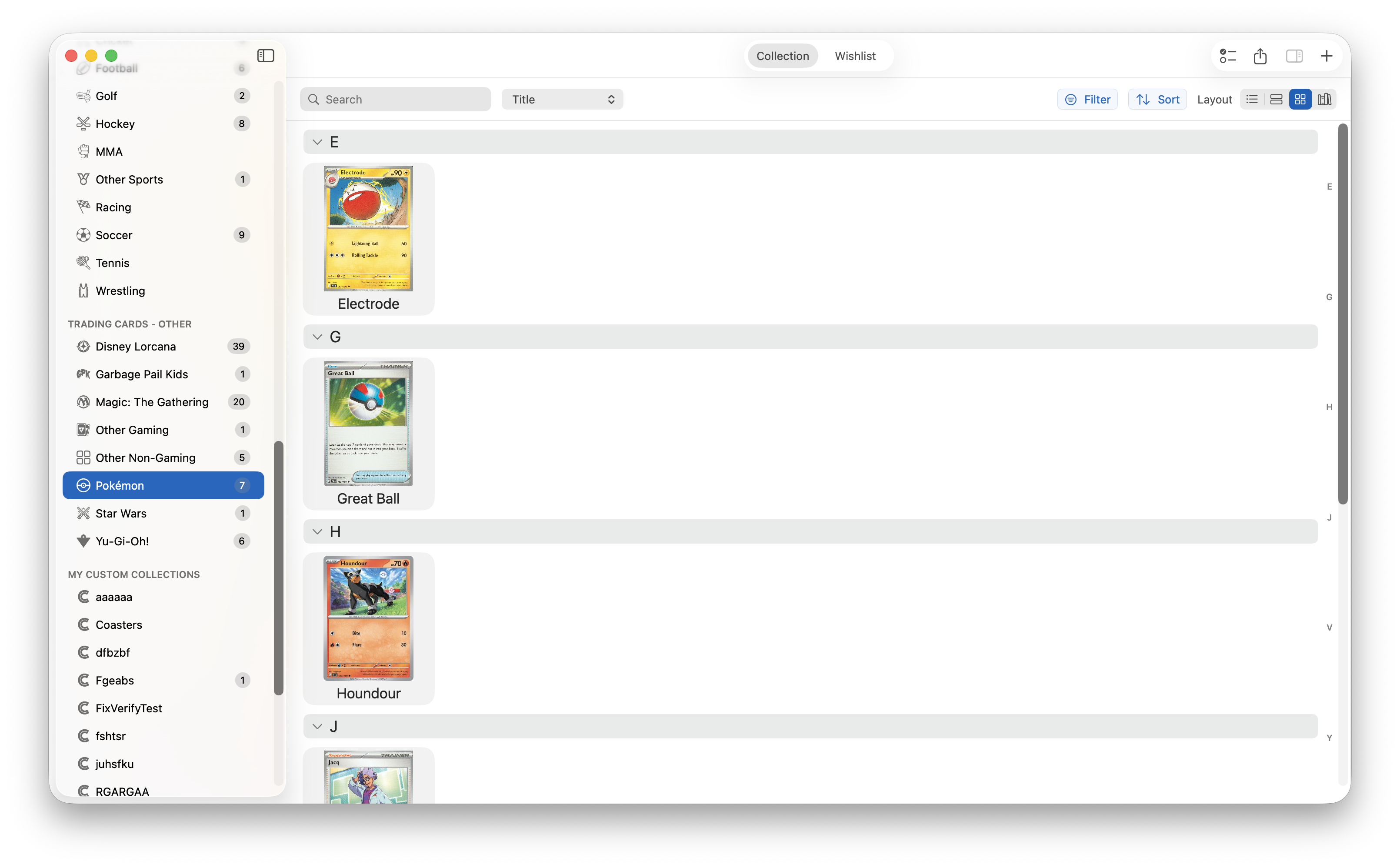
Once you have more than 50-100 cards worth tracking, you need a system. A spreadsheet works for a while. But once you hit several hundred cards across different sets, you want something that:
- Lets you scan barcodes on sealed products to add them
- Searches a database for individual singles
- Tracks estimated values
- Shows your total collection worth
- Works on your phone when you are at a card shop or convention
iCollect Everything does all of this. It covers Pokemon, Magic, Yu-Gi-Oh!, and all major sports card types in one app. If you also collect other things (most card collectors do), it handles those too.
 |
 |
Understanding Card Value
Card values come down to a few factors:
Rarity. Pull rates determine supply. A card that appears in 1 out of every 50 packs is worth more than one in every 3 packs.
Demand. Popular characters and star athletes drive demand. A rare card of a benchwarmer is still just a benchwarmer.
Condition. A mint card is worth 2-5x a lightly played one. For high-value cards, professional grading (PSA, CGC, BGS) locks in the condition and adds a premium.
Market timing. Card prices spike around events. Pokemon card prices rise around new set releases. Sports card prices spike during playoffs and award announcements. Buy before the spike if you can.
Frequently Asked Questions
What is the best trading card to start collecting?
Pokemon has the lowest barrier to entry and the most active community. Packs are available everywhere, singles are affordable for most cards, and the nostalgia factor means your collection will always have an audience. Magic: The Gathering is great if you want to play the game competitively. Sports cards are best if you follow a specific sport closely.
Are trading cards a good investment?
Some cards appreciate significantly over time, especially rookie cards of star athletes and chase cards from popular TCG sets. But cards are not stocks. Values can drop just as fast as they rise. Collect what you enjoy and treat any appreciation as a bonus.
How do I track what my cards are worth?
Download iCollect Everything (free on iPhone and Android) and catalog your cards. The app shows estimated values that update over time. For real-time single-card pricing, check TCGplayer (for game cards) or eBay sold listings (for sports cards).
Should I get my cards graded?
Only for cards worth $50+ in raw condition that you believe will grade PSA 9 or 10. Grading costs $20-$150 per card. A PSA 10 grade can double or triple value, but lower grades often add nothing over the raw price.
